Thermal responses of an emerging temperate mosquito reshape arboviral transmission risk

Thermal responses of an emerging temperate mosquito reshape arboviral transmission risk
Bahrami, R.; Da Re, D.; Khorramnejad, A.; Gingell, D. D.; Brustolin, M.; Müller, R.; Damiani, C.; Bonizzoni, M.; Mancini, M. V.
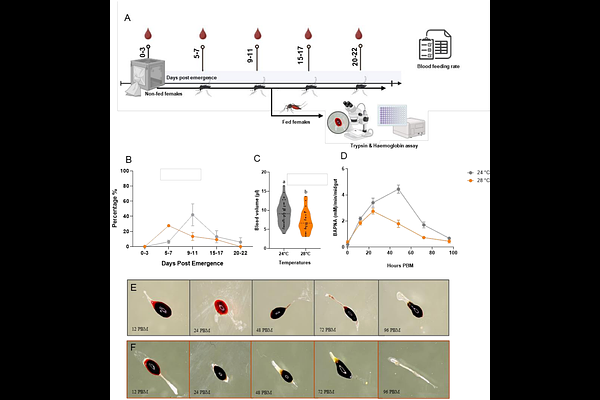
AbstractGlobal warming is known to increase arboviral disease risk by enabling the expansion of tropical vectors such as Aedes aegypti and Aedes albopictus. However, whether climate-driven shifts in seasonal dynamics within temperate regions, such as warmer springs and shorter winters, create thermal settings favourable for additional vectors, which can reshape disease risk maps, is poorly understood. To answer this question, we used the invasive temperate mosquito species Aedes koreicus and tested its thermal developmental resilience, along with its vector competence for dengue and chikungunya viruses. We observed significant phenotypic variation in thermal tolerance across life stages, which translates into distinct thermal performance curves for life-history traits, ultimately shaping overall mosquito fitness. We further found that temperature effects are virus-specific, with differential impacts on infection and transmission between dengue and chikungunya viruses. These stage- and pathogen-specific responses generate carry-over effects across life stages, indicating that thermal responses may be constrained by life-history trade-offs rather than be defined by a single thermal optimum. Our results highlight the need to move beyond static, species-based risk assessments toward mechanistic frameworks that integrate thermal biology across life stages and vector-pathogen systems. As climate change increasingly reshapes seasonal structure rather than simply elevating mean temperatures, cold-adapted and temperate vectors such as Ae. koreicus, provide critical model systems to understand how transmission risk emerges outside mosquito classical thermal optima, calling for a broader paradigm shift in how global change and vector-borne disease risk are conceptualised.