No-take zone effectiveness in linear coastal systems depends on spatially heterogeneous placement and larval dispersal directionality

No-take zone effectiveness in linear coastal systems depends on spatially heterogeneous placement and larval dispersal directionality
Saitou, M.; Chavarie, L.; Haugen, T.
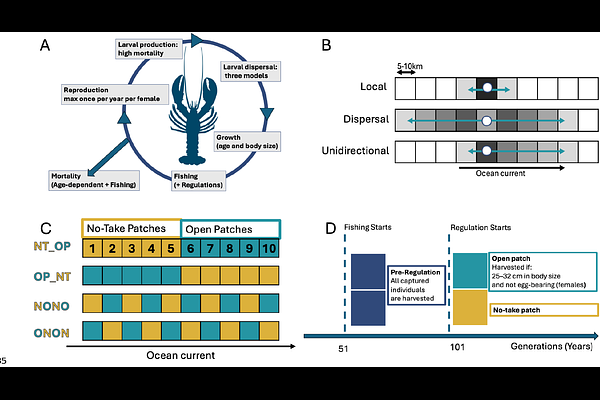
AbstractMarine protected areas (MPAs) are widely implemented to protect and/or rebuild exploited populations, yet their population-level effectiveness remains highly variable. Key unresolved knowledge gaps include how the size and the spatial placement of no-take zones interacts with larval dispersal directionality, particularly in linear coastal systems where connectivity is asymmetric. For sedentary species with planktonic larvae, such as European lobster, it is unclear under which dispersal regimes spatial configuration of protection critically determines positive demographic outcomes. Here, we address this gap using a spatially explicit individual-based model parameterized for the European lobster. We ask (i) whether no-take zones consistently enhance abundance and size structure relative to fished areas, and (ii) whether the positioning of no-take and open areas affects spatial protection while holding total protected area constant and (iii) how the alignment between larval dispersal direction and the positioning of no-take areas influences protection outcome. We contrast local, symmetric long-distance, and strongly unidirectional larval dispersal across alternative MPA layouts with equal total protected area but with different spacing. We show that no-take zones reliably increase abundance and the prevalence of large individuals. However, when larval dispersal is strongly unidirectional, population recovery depends on reserve placement: downstream no-take zones benefit from both larval import and local retention, whereas upstream reserves primarily export reproductive output and show limited local recovery. These results indicate that reserve performance cannot be evaluated independently of connectivity structure and identify dispersal directionality as a key determinant of when and where spatial configuration matters for MPA effectiveness in linear coastal systems.