Chronic therapy with α1A-adrenergic agonist reverses RV failure and mitochondrial dysfunction

Chronic therapy with α1A-adrenergic agonist reverses RV failure and mitochondrial dysfunction
Li, O. Y.; Swigart, P. M.; Reddy, N.; Myagmar, B.-E.; Bat-Erdene, E.; Simpson, P. C.; Baker, A. J.
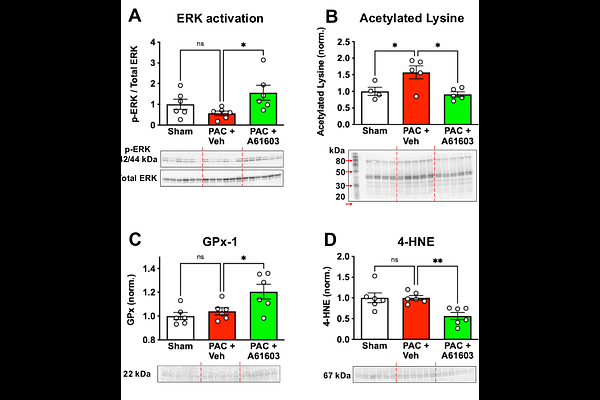
AbstractRight ventricular failure (RVF) is a serious disease with a high mortality but no effective pharmacologic treatments. We reported RVF was reversed by chronic treatment with an 1A-adrenergic receptor (1A-AR) agonist. Recent studies suggest mitochondrial dysfunction contributes to RVF. Therefore, we investigated if reversal of RVF by chronic 1A-AR agonist treatment involved improved mitochondrial function. A mouse model of RVF caused by pulmonary artery constriction (PAC) for 2 wk was chronically treated for a further 2 wk. with a low dose of the 1A-AR agonist A61603 (10 ng/kg/day) or vehicle (no drug control). RV dysfunction was assessed from the fractional shortening of the RV outflow tract (RVOT FS). RVOT FS for sham controls (46.5 {+/-} 1.3 %, n = 9) was reduced 4 wk after PAC (27.6 {+/-} 1.5 %, n = 13, P < 0.0001), but was higher after PAC plus 2 wk A61603 treatment (34.5 {+/-} 0.6 %, n = 14, P < 0.001). RV myocardial respiration rate (O2 consumption) for sham controls (776 {+/-} 51 pM/s/mg, n = 9) was reduced 4 wk after PAC (493 {+/-} 28 pM/s/mg, n = 15, P <0.0001), but was higher after PAC plus 2 wk A61603 treatment (634 {+/-} 30 pM/s/mg, n = 11, P <0.05). RV myocardial ATP level for sham controls (3.3 {+/-} 0.1 mM, n = 10) was reduced 4 wk after PAC (1.9 {+/-} 0.1 mM, n = 6, P < 0.0001), but was higher after PAC plus 2 wk A61603 treatment (2.6 {+/-} 0.13 mM, n = 7, P < 0.01). In conclusion, reversal of RVF after chronic A61603 treatment involved reversal of mitochondrial dysfunction. Consistent with our previous studies, this study suggests that the 1A-AR is a therapeutic target to treat RVF.