The hidden variability of the torus in local Active Galactic Nuclei: 20 years of Chandra, XMM-Newton, and NuSTAR observations

The hidden variability of the torus in local Active Galactic Nuclei: 20 years of Chandra, XMM-Newton, and NuSTAR observations
Vittoria Elvezia Gianolli, Nuria Torres-Alba, Stefano Marchesi, Marco Ajello, Claudio Ricci, Isaiah Cox, Massimo Gaspari, Dhrubojyoti Sengupta, Ross Silver, Indrani Pal, Andrealuna Pizzetti, Xiurui Zhao
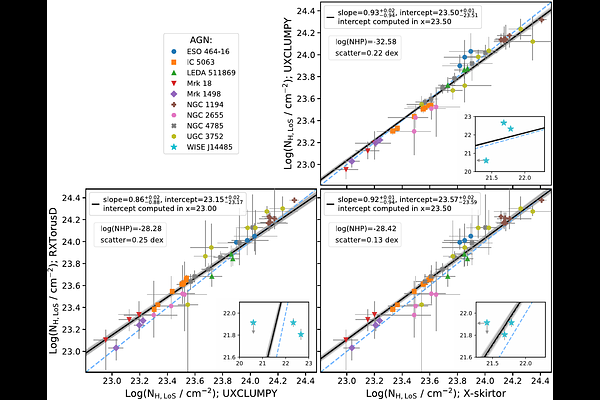
AbstractX-ray absorption variability in active galactic nuclei (AGN) provides key constraints on the structure and dynamics of the circumnuclear obscuring medium, the so-called torus. A fraction of nearby AGN, however, have been classified as non-variable in line-of-sight (LoS) column density based on limited temporal coverage. We present the first systematic study of a sample of 11 local (z $\leq$ 0.1) obscured (N$_{\rm H} \geq 10^{22}$ cm$^{-2}$) AGN, initially classified as non-variable. The sample is selected from the Swift-BAT 100-month catalog, and comprises 60 observations from Chandra, XMM-Newton, and NuSTAR, spanning timescales from days to nearly two decades. We simultaneously model all available spectra for each source adopting physically motivated torus models: X-skirtor, RXTorusD, and UXCLUMPY. This approach allows us to derive the global properties of the obscurer while tracking possible epoch-to-epoch variations in the LoS column density and intrinsic X-ray emission. We find that the original non-variable classification (based on only two X-ray observations) is frequently not robust: clear N$_{\rm H,LoS}$ variability is detected in half of the sample, whereas 7 out of 10 AGN require intrinsic flux variability, with the rest showing flux-N$_{\rm H,LoS}$ degeneracies. We also find that the probability of identifying absorption variability increases with the number of observations, and the largest column density changes preferentially occur on long timescales, consistent with absorption by extended, structured clouds on torus scales. These findings support a clumpy and dynamic obscuring medium as a common feature of nearby AGN and highlight the importance of long-term X-ray monitoring for accurately characterizing AGN obscuration.