Molecular gas hidden in plain sight in the early Universe

Molecular gas hidden in plain sight in the early Universe
Pasquier Noterdaeme, Jens-Kristian Krogager, Sergei Balashev
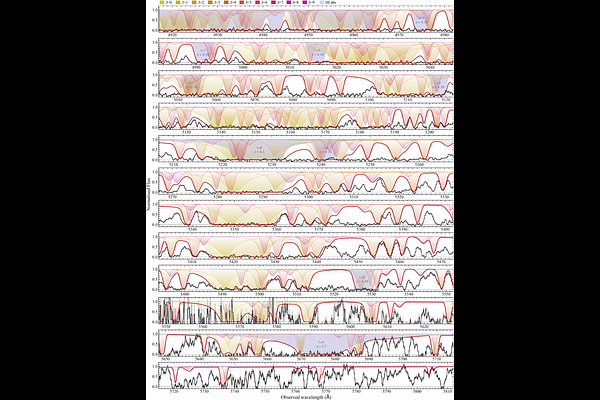
AbstractWe report the discovery of an extreme intervening molecular absorber at zabs = 4.1 towards the z = 4.7 quasar SDSS J080023.02+305101.22 revealed through strong H2 absorption that had remained unnoticed in archival data for about two decades. The system, which we analysed with new VLT/X-shooter observations, has a metallicity of about one-fifth the solar value, in line with the moderate dust reddening AV~0.06 mag. More strikingly, it exhibits the highest molecular fraction, fH2 = 2N(H2)/(2N(H2) + N(HI))~=60%, measured at z>0 from direct determinations of both atomic and molecular hydrogen column densities. Notably, this fraction is comparable to the very highest values in the Local Group. The inferred fH2 still represents a conservative lower limit to the local molecular fraction since the H i absorption very likely includes atomic gas unrelated to the actual molecular component, as indicated by the wide (Delta v~500 km/s) multi-component low-ionisation metal profile. The detection of such a system at early cosmic times is remarkable given the limited number of quasar spectra probing z>4. It suggests an unexpectedly high incidence of H2, with important implications for the evolution of molecular gas. This high incidence may be driven by high average densities and enhanced turbulence at those redshifts. At the same time, our results also highlight possible observational biases, both in quasar selection and in recognising strong H2 absorption, suggesting that a significant fraction of molecular gas may remain undetected, in particular near the peak of star formation. The present system offers a unique benchmark for developing efficient detection algorithms. Further progress will benefit from colour-independent quasar surveys, while constraining the physical conditions and environments of such extreme absorbers will require observations on future extremely large telescopes.