Systematic identification of cell division proteins in haloarchaea and the discovery of a membrane anchor for the Z ring

Systematic identification of cell division proteins in haloarchaea and the discovery of a membrane anchor for the Z ring
Du, S.; Zheng, W.; Zhao, S.; Liu, Y.; Cui, J.; Wu, J.; Zou, X.; Li, Y.; Gong, H.; Chen, X.; Lutkenhaus, J.; Wu, F.
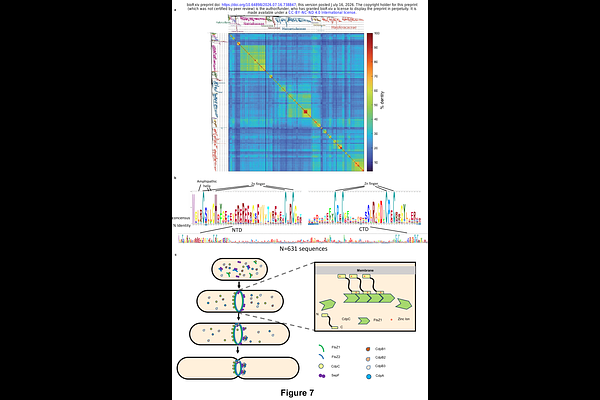
AbstractMost archaea rely on the tubulin-like protein FtsZ for division. In the last decade, several novel cell division proteins have been discovered in the model haloarchaeon Haloferax volcanii which contains two FtsZ proteins, FtsZ1 and FtsZ2. However, the composition of this FtsZ-based archaeal divisome is largely uncharacterized. Here, using in vivo crosslinking coupled with immunoprecipitation and mass spectrometry (CLIP-MS), we identified ten proteins that localize to the division site, including wide-spread proteins predicted to be involved in DNA binding and energy metabolism. Deletion analysis indicate that most of these proteins have a modest or minor impact on cell division, but HVO_0399, renamed as Cell Division Protein C (CdpC), is important for cell division and functions as a membrane anchor for FtsZ1. CdpC consists of three domains, an N-terminal domain (NTD) containing an amphipathic helix critical for membrane binding, a long intrinsically disordered linker, and a C-terminal domain (CTD) that binds FtsZ1 with high affinity and likely promotes its polymerization. Notably, both the NTD and CTD of CdpC harbor a zinc finger that is indispensable for its function. Phylogenetic analysis indicates that CdpC sequences evolved fast across haloarchaea, but exhibited high conservation in domain structure and critical residues found in this study. Overall, our study expands the repertoire of candidate division proteins and establishes CdpC as a membrane anchor for FtsZ1 in haloarchaea. These findings pave the way for in-depth studies of arcaheal cell division and broaden the function of zinc finger proteins in archaea.