Gastric-brain coupling dynamics in response to a cognitive challenge reveal distinct autonomic and psychological correlates in healthy individuals and patients with irritable bowel syndrome

Gastric-brain coupling dynamics in response to a cognitive challenge reveal distinct autonomic and psychological correlates in healthy individuals and patients with irritable bowel syndrome
Jeanne, R.; Minjoz, S.; Bonaz, B.; Sinniger, V.; Hot, P.; Kibleur, A.; Pellissier, S.
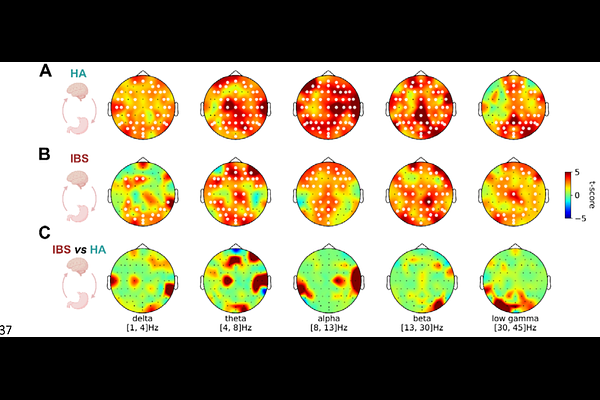
AbstractThe gastric's intrinsic slow-wave rhythm couples to ongoing cortical activity in humans, but the functional significance of this gastric-brain coupling remains poorly understood. Using simultaneous electroencephalography and electrogastrography, we examined how gastric-brain coupling changes during a mental task and subsequent recovery and whether these dynamics relate to autonomic responses in healthy adults (HA) and individuals with Irritable Bowel Syndrome (IBS), a disorder of gut-brain interactions. In HA, gastric-brain coupling decreased during mental task and gradually returned to baseline during recovery, primarily for cortical alpha rhythms. Greater reductions in gastric-brain coupling were associated with stronger sympathetic arousal, indicating that gastric-brain coupling is associated with physiological responses to cognitive demand. In IBS, gastric-brain coupling dynamics were preserved. However, unlike HA, sympathetic arousal was not associated with gastric-brain coupling reductions, suggesting an alteration in the functional relationship between gastric-brain coupling and autonomic regulation despite preserved coupling dynamics. Further, in HA, greater reductions in gastric-brain coupling were associated with higher anxiety and neuroticism and lower interoceptive awareness. In contrast, these relationships were reversed in IBS, with greater gastric-brain coupling dynamics observed in individuals with higher anxiety and neuroticism and lower interoceptive awareness. Together, gastric-brain coupling emerges as a dynamic physiological process associated with autonomic responses to cognitive demand. In IBS, these dynamics are preserved but their physiological and psychological associations are altered, indicating a dissociation between gastric-brain coupling and its functional correlates.