Fast pre-merger detection of massive black-hole binaries in LISA based on time-frequency excess power

Fast pre-merger detection of massive black-hole binaries in LISA based on time-frequency excess power
Francesco Nobili, Malvina Bellotti, Riccardo Buscicchio, Massimo Dotti, Alessandro Lupi
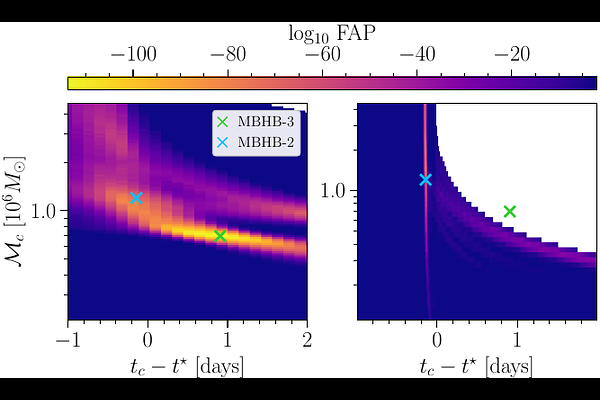
AbstractThe Laser Interferometer Space Antenna is expected to observe gravitational waves from massive black hole binaries across cosmic time. Many are anticipated to be detectable hours to weeks before coalescence. We present a fast algorithm for the pre-merger detection and preliminary characterization of such binaries. The method performs a search for excess power with a chirping time-frequency morphology in short-time Fourier transform spectrograms. By tiling the time-frequency plane with slices defined by the quadrupole frequency evolution, we define a signal significance relative to a fitted background distribution of instrumental noise and Galactic foreground. Individual search triggers are followed by a coherence tracker, which groups over time triggers consistent with the same physical signal . Doing so, our analysis provides progressively refined estimates of the chirp mass and coalescence time. We validate our algorithm on the Sangria LISA Data Challenge dataset, successfully detecting all 15 injected MBHBs: 14 of them hours-to-weeks before merger, while one is only detected after the binary coalescence. The algorithm yields chirp mass relative errors below $3\%$ for high-SNR sources and coalescence time uncertainties of up to a few hours. With a computational cost of less than a second to process a 10-day data segment on single core, our approach is suitable for generating real-time alerts, trigger protected observational periods, and provide informative priors for Bayesian parameter estimation.