Reliability and Spatiotemporal Autocorrelation of Acoustic Indices: Implications for Biodiversity Monitoring

Reliability and Spatiotemporal Autocorrelation of Acoustic Indices: Implications for Biodiversity Monitoring
Jiang, X.; Zhang, Y.; Shu, Z.; Xiao, Z.; Wang, D.
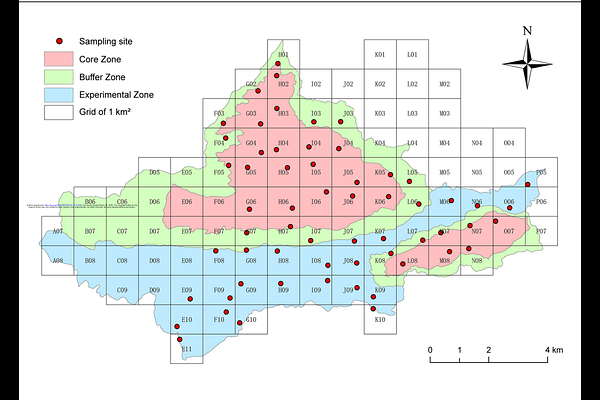
AbstractPassive acoustic monitoring (PAM) is increasingly applied in biodiversity research, yet its reliability as a proxy for biodiversity remains insufficiently evaluated. In particular, the spatiotemporal autocorrelation inherent in acoustic indices of PAM is rarely quantified, despite its importance for the standardized application of acoustic monitoring. We conducted an integrated study to investigate these issues using a complete grid-based monitoring system covering the entire region (100 grids of 1 km x 1 km) in southern subtropical climatic zones. Acoustic data from 58 valid sites were combined with camera-trapping and vegetation surveys to evaluate six commonly used acoustic indices in PAM. We found that these indices were more strongly associated with relative abundance and community diversity metrics of bird and mammal than with species richness. Spatially, autocorrelation ranges of some acoustic indices extended to approximately 4 km (i.e., the Bioacoustic Index (BIO) and Normalized Difference Soundscape Index (NDSI)). Temporally, all indices exhibited significant autocorrelation over 2-5 days, exceeding the typical short-term turnover of bird and mammal activity (1-2 days). Our results indicate that acoustic indices are not direct proxies for species richness but provide complementary information on soundscape dynamics. By explicitly quantifying spatiotemporal autocorrelation, this study offers practical guidance for sampling design and statistical analysis in passive acoustic monitoring, supporting more reliable and efficient biodiversity assessment.