Genomic and biochemical contexts determine the physiological role of a horizontally acquired gene

Genomic and biochemical contexts determine the physiological role of a horizontally acquired gene
Bruna, R. E.; Selvaraj, A. L.; Bhowmik, S.; Kendra, C. G.; Heister, R. W.; Pontes, M. H.
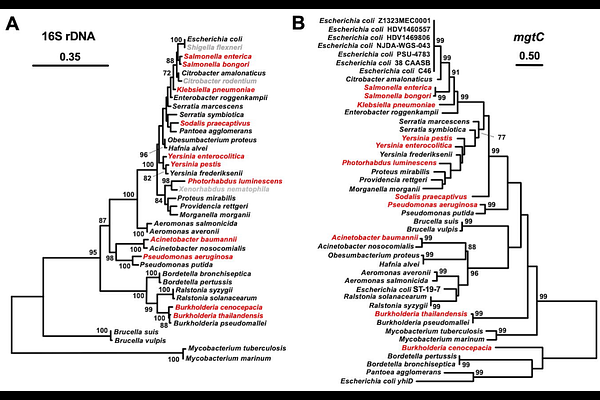
AbstractThe horizontally acquired mgtC gene from Salmonella enterica confers this bacterium the abilities to survive episodes of magnesium (Mg2+) starvation, and to replicate in mammalian macrophages. The former property allows bacteria to persist in the environment through periods of Mg2+ depletion, whereas the latter allows S. enterica to overcome self-limiting intestinal colonization and cause an invasive systemic infection in susceptible mammalian hosts. Even though the biochemical function of MgtC is not completely understood, this protein is thought to function primarily by preventing the production of toxic levels of Mg2+-chelating adenosine triphosphate (ATP). In the current work, we investigated the physiological roles of mgtC homologs from an array of bacterial species, by probing the processes controlled by this gene during replication in low Mg2+ medium and in macrophages. We determined that MgtC homologs that do not participate in Pi homeostasis during Mg2+ starvation and do not promote intramacrophage replication in their resident species can partake in these processes when expressed in S. enterica. This indicates that the function of this protein is context-dependent. Accordingly, we show that the physiological processes affected by S. enterica MgtC vary, depending on whether the bacteria replicate in low Mg2+ medium or inside macrophages. While these results suggest that MgtC is a regulator, they also demonstrate that horizontally acquired genes can assume different roles, depending on the genome and the biochemical context into which they are inserted.