Geant4-IcyMoons: Simulating Electron Interaction Physics in Irradiated Astrophysical Ices

Geant4-IcyMoons: Simulating Electron Interaction Physics in Irradiated Astrophysical Ices
Gideon Yoffe, Jacques Pienaar, Ioanna Kyriakou, Dimitris Emfietzoglou, Sébastien Incerti, Hoang Tran, Yohai Kaspi
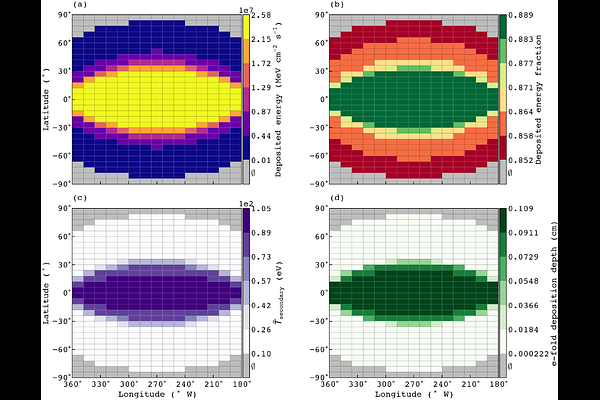
AbstractEnergetic particles continuously process water ice across astrophysical and planetary environments, from interstellar clouds and comets to icy planetary surfaces. Interpreting the resulting observables requires a physically grounded description of the underlying interactions, both to identify radiation-driven signatures and to distinguish them from superimposed chemical, thermal, and microphysical effects. We present Geant4-IcyMoons, an extension of Geant4-DNA developed for irradiated water ice and, ultimately, for materials embedded within it. In this study, we model the elastic and inelastic interactions of electrons with amorphous and hexagonal ice. For the first time, this enables a transport-ready Monte Carlo simulation of electron irradiation in water ice, linking incident-particle environments to the evolution of icy surfaces. We apply this framework to Jupiter's moon Europa as a representative case of electron bombardment of an icy surface. We show that, on the trailing hemisphere, the stronger low-energy electron bombardment confines much of the deposited energy to the upper $\lesssim 0.1$~cm, whereas on the leading hemisphere, the more energetic incident population drives deposition patterns to depths of tens of centimeters. This may contribute to the observed lens-like enrichment of radiolysis products centered on the equator of the trailing hemisphere. This work lays the foundation for treatments of ion irradiation and radiation chemistry in water ice and embedded materials.