Geomorphic evolution of a Caribbean biological hotspot

Geomorphic evolution of a Caribbean biological hotspot
O'Dea, A.; Titcomb, M.; Anderson, L. H.; de Gracia, B.; Flantua, S.; Hynes, M. G.; Parsons, T.; Schloeder, C.; Braun, M. J.
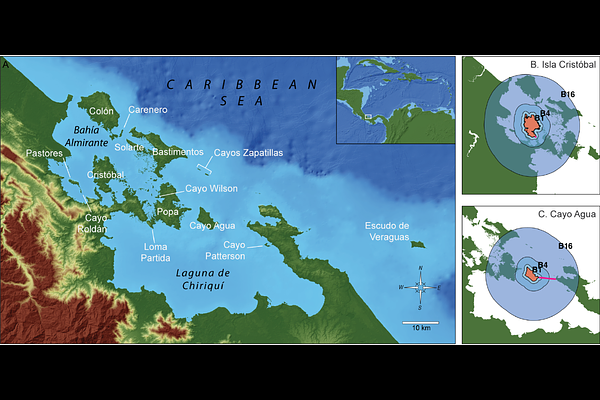
AbstractContinental shelf islands provide tractable systems for understanding how geomorphic history shapes ecological and evolutionary processes, yet most near-shore archipelagos lack comprehensive integration of spatial configuration and temporal dynamics. Here we reconstruct the land-sea geomorphic history of the Bocas del Toro Archipelago, Panama, combining high-resolution bathymetry and topography with a Caribbean sea-level model corrected for sediment accumulation and tectonic movement. We quantify present-day multi-scale isolation, historical fragmentation dynamics, and composite metrics integrating spatial and temporal dimensions. Islands became isolated sequentially from 9.5 to 2.9 ka, with area contraction rates varying twentyfold amongst islands. Island number peaked at 40 around 7 ka before declining to 32 today as rising seas submerged smaller islands, whilst shallow marine habitat (0-10 m depth), where most coral reef, seagrass, and mangrove ecosystems develop, expanded nearly fivefold to peak at ~9 ka before declining to 65% of that maximum by the present. Extending analyses through the Pleistocene reveals the modern archipelago is highly atypical: for over half of the last million years, the region existed as continuous coastal lowland rather than islands. Projections under moderate emissions scenarios predict ~5% loss of terrestrial habitat but ~50% expansion of shallow marine habitat by 2150, though whether degraded Caribbean reefs can exploit this expansion remains uncertain. Exploratory correlations between species richness of five terrestrial vertebrate groups (from Smithsonian museum collections) and geomorphometric predictors reveal that island area, maximum elevation, and cumulative habitat availability since isolation are the strongest correlates of diversity, whilst buffer-zone isolation indices developed for oceanic volcanic archipelagos perform poorly in this continental shelf context. This framework provides a time-calibrated foundation for testing how millennial-scale habitat dynamics shape biodiversity patterns across taxa with contrasting dispersal capabilities.