The Circumbinary Disc of HD 34700A II. Analysis of a strong dust asymmetry

The Circumbinary Disc of HD 34700A II. Analysis of a strong dust asymmetry
Daniele Fasano, Myriam Benisty, Jochen Stadler, Francesco Zagaria, Alexandros Ziampras, Andrew J. Winter, Jaehan Bae, Stefano Facchini, Nicolás T. Kurtovic, Enrico Ragusa, Richard Teague
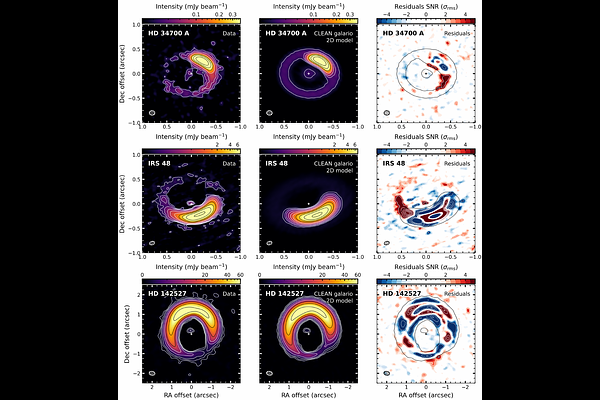
AbstractALMA observations have shown that substructures are ubiquitous in protoplanetary discs. A sub-group, the transition discs, shows large cavities and rings in dust continuum. Among these, some present very high contrast asymmetries possibly due to the presence of vortices. HD 34700A is a binary system featuring a cavity, a ring, and multiple spiral arms detected in scattered light, a prominent crescent in the ALMA continuum and a complex gas morphology possibly connected with ongoing infall. We present new ALMA band 6 (1.3 mm) continuum images of the circumbinary disc around HD 34700A and compare them with two other systems showcasing high ($\gtrsim30$, measured as the peak-to-azimuthal-average ratio) contrast continuum asymmetries, IRS 48 and HD 142527. We aim to characterise the crescent morphology and discuss their possible origin. We perform visibility modelling of the new high resolution (0.''11x0.''09) ALMA band 6 continuum data of HD 34700A, together with improved visibility modelling of the other two targets. Our visibility model is in remarkable agreement with the HD 34700A data, featuring only localised residuals in the region of the disc corresponding to the tail of the asymmetry. We reproduce the double-peaked emission in HD 142527, and recover the crescent shape in IRS 48. We then run a hydrodynamic model of a vortex with different dust fluids, reproducing the general asymmetric crescent morphology observed in the HD 34700A and IRS 48 systems. With a combination of visibility, dust evolution and hydrodynamical models, we have constrained the morphology of the dust continuum emission of HD 34700A for the first time, and improved existing models for IRS 48 and HD 142527. The high azimuthal contrast of the asymmetries rules out the orbit clustering of eccentric cavities scenario, while the dust evolution models we consider suggest that the vortex scenario is a plausible option.