Site Quality Analysis for an Indian Submillimeter Telescope: A Reanalysis-Based Approach

Site Quality Analysis for an Indian Submillimeter Telescope: A Reanalysis-Based Approach
Tanmay Singh, Mayuri Sathyanarayana Rao, Ritoban Basu Thakur
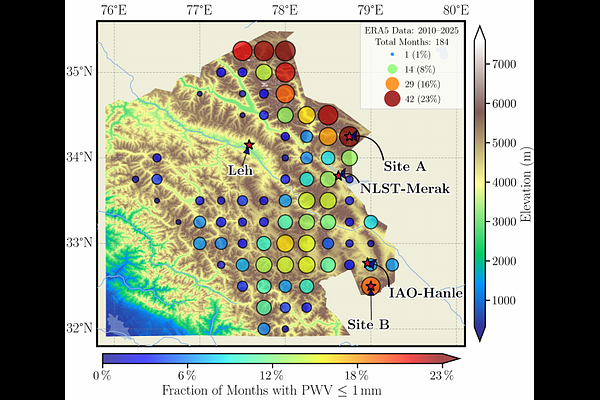
AbstractThe Himalayan plateau region of Ladakh, India, is a potential host for a science-class submillimeter observatory, building on existing astronomical infrastructure near Hanle and Merak. Using the fifth-generation European Centre for Medium-Range Weather Forecasts (ECMWF) Reanalysis (ERA5) data, we analyze precipitable water vapor (PWV) at monthly resolution over 184 months from January 2010 to April 2025, map PWV statistics across Ladakh, and identify candidate regions that reach PWV $\leq 1$ mm. For promising locations, we compute atmospheric transmittance and the corresponding atmospheric photon noise using the am (Atmospheric Model) radiative transfer code; we present transmittance and brightness temperature estimates over 10--1000 GHz and compare the inferred performance to sites hosting current or planned submillimeter facilities worldwide. We find Ladakh to be favorable for submillimeter observations, with multiple ERA5 grid cells reaching PWV $\leq 1$ mm. Within ERA5's spatial resolution, two regions emerge as particularly promising: Site A ($\approx 34.25^\circ$N, $78.75^\circ$E) and Site B ($\approx 32.50^\circ$N, $79.00^\circ$E), which satisfy PWV $\leq 1$ mm for about 23% and 19% of the study duration, respectively, compared to about 5% and 8% for the Hanle and Merak grid cells. These results motivate targeted in situ radiometer measurements for final site selection.