HECATEv2: An all-sky galaxy catalogue for multimessenger astrophysics

HECATEv2: An all-sky galaxy catalogue for multimessenger astrophysics
E. Kyritsis, A. Zezas, K. Kovlakas, C. Daoutis, K. Kouroumpatzakis, A. Hornschemeier, A. Basu-Zych
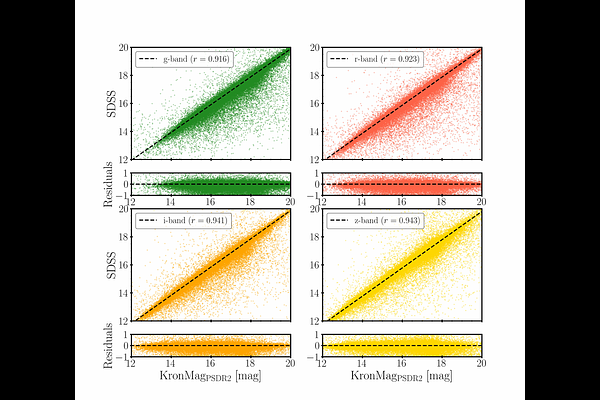
AbstractWe present HECATEv2, the second release of the Heraklion Extragalactic Catalogue (HECATE), an all-sky, value-added galaxy catalogue comprising 204733 galaxies from the HyperLEDA database with recession velocity <14000 km/s (D~200 Mpc). This release focuses on qualitative upgrades of the provided information while maintaining the same parent galaxy sample as HECATEv1. Improvements include a new cosmology-based distance framework, expanded and homogenised optical and mid-infrared photometry from SDSS-DR17/NSA, PS1-DR2, and AllWISE, and new quality-control flags for stellar contamination, incorrect photometry, and coordinate inconsistencies. We also extend the galaxy-size coverage and derive stellar population parameters for a substantially larger fraction of the sample. Star-formation rates (SFR) and stellar masses (Mstar) are now available for >70% of galaxies using updated mid-IR/optical calibrations that account for stellar population age and dust attenuation, while gas-phase metallicities are derived for ~90%. Activity classifications are provided for >50% of galaxies based on spectroscopic and/or photometric diagnostics, and supermassive black hole masses for ~86%. In terms of L$_{B}$,L$_{Ks}$,SFR, and Mstar, HECATEv2 is among the most complete local-Universe catalogues with spectroscopic redshifts. We also provide spatial completeness maps as a function of distance and luminosity, highlighting variations across the sky. Compared to other catalogues (e.g. GLADE+, NED-LVS), HECATEv2 offers broader (optical, near- and far-IR photometry, metallicity, activity classifications) or comparable (mid-IR photometry, SFR, Mstar) coverage, making it a robust reference for studies of SMBH-host galaxy connections, gravitational-wave and high-energy transient hosts, population analyses, and rare galaxy subpopulations.