Resolving the smallest scales of massive star formation: A case for next-generation thermal-infrared interferometers

Resolving the smallest scales of massive star formation: A case for next-generation thermal-infrared interferometers
Emma Bordier, Evgenia Koumpia, Lucas Labadie, Joel Sanchez-Bermudez, Alvaro Sanchez-Monge, Jean-Philippe Berger
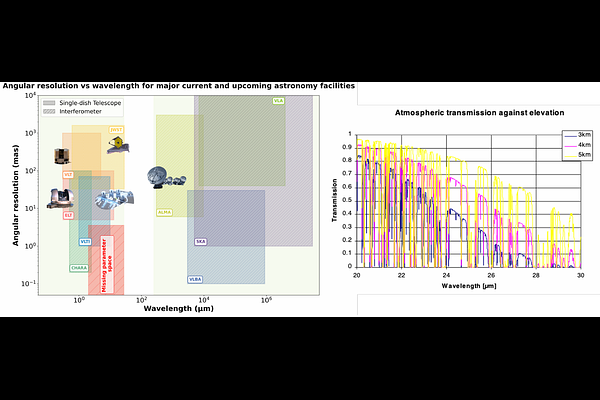
AbstractThis white paper was submitted to the European Southern Observatory (ESO) as part of the "Expanding horizons: transforming astronomy in the 2040s" call. Understanding how massive stars assemble their mass is a major astrophysical challenge, primarily because the critical accretion, ejection, and fragmentation processes occurring within the innermost 100 au remain largely inaccessible. Current facilities, such as ALMA and near-infrared interferometers, either lack the resolution to probe the compact high-mass star-disk interaction zone or are severely hindered by high extinction and marginal spectral resolution. To bridge this observational gap, this white paper advocates for next-generation thermal-infrared interferometers operating in the L, M, N, and Q bands to directly observe warm dust, hot gas, and embedded protostars at sub-milliarcsecond scales. These advanced capabilities will provide unprecedented access to a rich molecular inventory and spatially resolved spectroscopy, which are crucial for disentangling accretion streams, disk winds, and fragmentation mechanisms on dynamical timescales. We propose that developing heterodyne-based, long-baseline interferometry at high, dry sites represents the most transformative and realistic pathway to finally unveil the complete picture of massive star formation.