Capture of interstellar objects during stellar encounters

Capture of interstellar objects during stellar encounters
Sean N. Raymond, Nathan A. Kaib, Matthew J. Hopkins
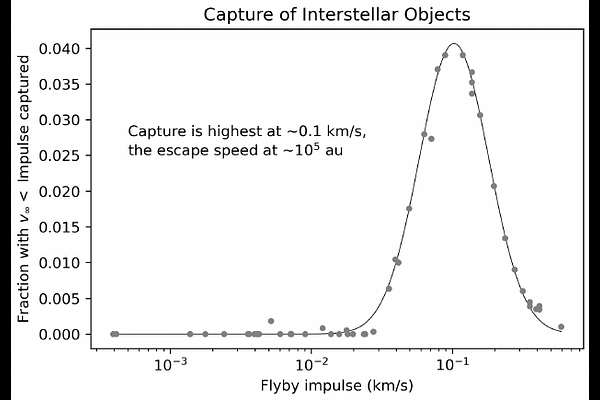
AbstractAs they orbit within the Galaxy, stars swim through a vast population of interstellar objects (ISOs). In this paper, we use N-body simulations to show that a fraction of ISOs within $\sim$1 pc of the Sun (its tidal radius) may be captured during the flyby of another star -- a mechanism that requires no planets. Capture is most efficient when the impulse imparted by the flyby is comparable to the escape speed at the widest stable orbit, which is roughly 0.1 km/s for the Sun. ISO capture is dominated by the few highest-impulse stellar flybys, typically involving relatively slow encounters with massive stars. Most ISOs are captured in the outer parts of the Oort cloud, with semimajor axes greater than $\sim$50,000 au. Using Monte Carlo simulations, we show that the Sun underwent only a small number of ISO-capturing flybys in its history (median [mean] of 1 [1.7]). Using the {Ō}tautahi-Oxford population model, we estimate that a few times $\sim$$10^{4}$ `Oumuamua-sized ISOs were likely captured by the Sun. This only represents a $\sim$$10^{-8\pm1}$ contribution to the total Oort cloud population, yet it contains roughly as many present-day captured ISOs as Jupiter-assisted capture provides. Given that flybys are unavoidable in the Galactic field, most stars should, at any given time, host have sparse Oort clouds populated with ISOs captured during stellar flybys. Massive stars are both the main drivers of capture when they fly by a given star, and more efficient at capturing ISOs around themselves than low-mass stars.