SSR42 Enhances the Hemolytic Capacity of Staphylococcus aureus by Stabilizing the hla mRNA

SSR42 Enhances the Hemolytic Capacity of Staphylococcus aureus by Stabilizing the hla mRNA
Jobson, M.-E.; Tomlinson, B. R.; Jackson, J.; Shaw, L. N.
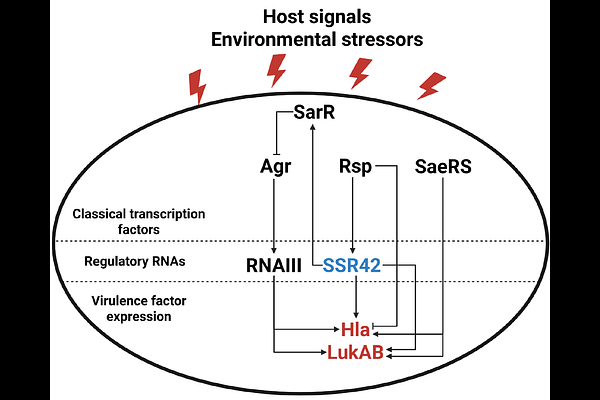
AbstractStaphylococcus aureus utilizes a complex regulatory network to precisely control a vast array of virulence factors and facilitate infection. One such regulator, the long regulatory RNA SSR42, is emerging as a key modulator of virulence factor abundance and pathogenesis. Previous work has shown that a primary role for SSR42 is controlling hemolytic behavior through the positive regulation of -toxin (hla/Hla). Herein, we confirm that loss of SSR42 limits hemolytic capacity due to reduced Hla production. Others have suggested that this occurs through the SaeRS two-component system; however, using epistasis experiments, we reveal that SSR42 and SaeRS function independently to control Hla activity. Using a two-plasmid system optimized to detect regulatory RNA-mediated control in Gram-positive bacteria, we demonstrate that SSR42 directly enhances Hla production through the hla 5' untranslated region. Using interaction prediction and targeted mutagenesis, we identify a discrete site upstream of the hla ribosome-binding site that is required for SSR42 binding and hemolytic activity. Transcriptional arrest experiments further show that SSR42 stabilizes the hla mRNA, increasing its half-life and promoting downstream toxin production. Finally, electrophoretic mobility shift assays confirm a specific interaction between SSR42 and the hla 5' UTR. Collectively, these findings establish SSR42 as a major post-transcriptional regulator of S. aureus virulence and reveal a novel RNA-mediated mechanism that promotes -toxin production through stabilization of the hla transcript.