Data-driven characterisation of variable source light curves with multimodal representation learning

Data-driven characterisation of variable source light curves with multimodal representation learning
M. Madarász, G. Marton, M. Audard
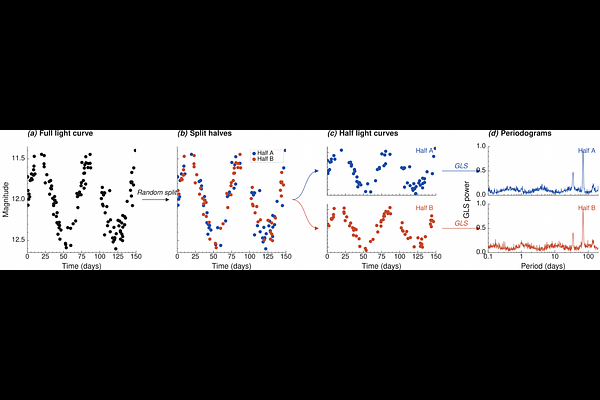
AbstractSurveys such as the Zwicky Transient Facility (ZTF) and the Vera C. Rubin Observatory Legacy Survey of Space and Time (LSST) produce light curves for hundreds of millions of variables. Their characterisation traditionally relies on supervised classifiers with hand-crafted features and curated labels, limiting them to predefined taxonomies and individual surveys. We present a general, survey-agnostic framework that characterises variable sources without labelled training data, producing low-dimensional representations of light curve properties such as amplitude, periodicity, and asymmetry. A multimodal architecture combines two complementary views, a Transformer encoder on raw observations and a convolutional neural network on a generalised Lomb-Scargle periodogram. Each light curve is randomly split into two temporal halves as independent views, and the branches are trained jointly with VICReg to produce embeddings invariant across halves while keeping each dimension informative. We evaluate on 37 006 ZTF sources spanning 14 variable star classes in four broad physical categories. A linear classifier on the frozen 64-dimensional embeddings achieves 77.1% balanced accuracy for classes and 90.5% for broad categories. Combining both branches improves balanced accuracy by up to 14.9 percentage points over the best single modality, confirming their complementarity. Interpretable light curve properties are encoded on distinct dimensions, and within-class analysis reveals physical substructure unresolved by reference labels. Retraining on ZTF g and i bands without modification reproduces the main results, and concatenating multi-band embeddings improves balanced accuracy to 86.1%. The framework needs no labels, phase folding, or survey-specific preprocessing and applies directly to other surveys with different cadences and wavelength coverage.