The majority of hot Jupiters formed beyond the water ice line

The majority of hot Jupiters formed beyond the water ice line
Yaxing He, Bertram Bitsch, Adrien Houge, Joe Williams, Masahiro Ogihara
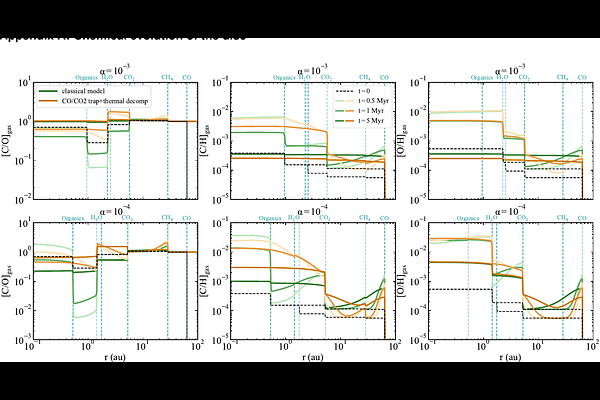
AbstractAtmospheric compositions of giant exoplanets can retain information about their formation environments, as volatile species condense at different temperatures in protoplanetary discs. We investigated whether the atmospheric compositions of hot Jupiters can constrain their formation locations. We performed planet formation simulations using the ChemComp code, including pebble drift, pebble and gas accretion, planet migration, stellar abundances, and two additional chemical processes: thermal decomposition of refractory organics and CO/CO2 trapping in water ice. We applied this framework to nine observed hot Jupiter systems and compared the resulting atmospheric metallicities (C/H and O/H) with observational constraints. We found that the observed atmospheric abundances of the nine hot Jupiter systems can be reproduced by planets forming at different locations relative to the H2O and CO2 snowlines. Our results suggest that at least six of the nine systems are consistent with formation beyond the H2O snowline. Combined with the observed orbital separations, eccentricities, and spin-orbit obliquities, these inferred formation locations indicate that many systems likely experienced dynamical scattering followed by tidal evolution. Atmospheric abundances, in combination with detailed orbital parameters, can provide a powerful diagnostic of the formation and migration histories of hot Jupiter systems, opening up avenues to understand the origin of giant planets in general.