Prevailing thermally-pulsing-asymptotic-giant branch stars in the near-infrared rest-frame spectra of distant quiescent galaxies: towards robust galaxy ages and masses

Prevailing thermally-pulsing-asymptotic-giant branch stars in the near-infrared rest-frame spectra of distant quiescent galaxies: towards robust galaxy ages and masses
Shiying Lu, Emanuele Daddi, Claudia Maraston, Alvio Renzini, Mark Dickinson, Pablo Arrabal Haro, Daniel Thomas, Luis Gabriel Dahmer-Hahn, Raphael Gobat, Mauro Giavalisco, Anton M. Koekemoer, Ray A. Lucas, Fabio Pacucci, L. Y. Aaron Yung, Michaela Hirschmann, Benne Holwerda
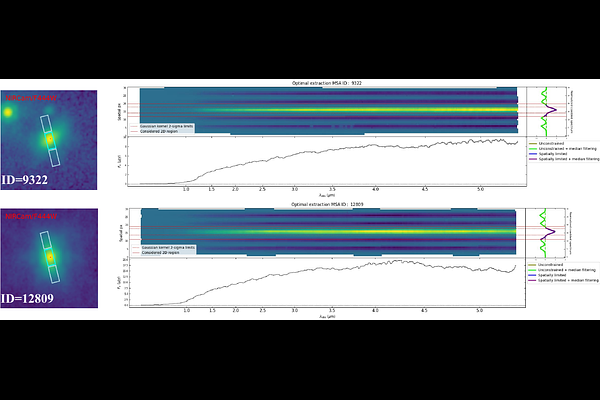
AbstractWe recently reported the discovery of prominent features from the thermally pulsing asymptotic giant branch (TP-AGB) phase in the near-IR rest-frame of a massive quiescent galaxy (QG) at z~1 observed with JWST, which set strong constraints on population synthesis models. Here we compare those results against similar measures from a much larger sample of JWST/NIRSpec PRISM spectra for 27 QGs at z>1 from programs GO-5019 and CEERS, with signal-to-noise ratios of ~100 (15/27) and ~50 (12/27), respectively. Each spectrum is modeled with three stellar population synthesis models: the latest Maraston (M13) models with a sizable TP-AGB phase, the Bruzual & Charlot 2003 (BC03) models, and the Conroy & Gunn (2009, C09) models, both of which include TP-AGB contributions of smaller magnitude. The M13 model generally provides the best fit quality. Compared to BC03 and C09, M13 yields systematically younger mass-weighted ages (by <500 Myr) hence lower stellar masses (by >0.2 dex). All models favor super-solar (Z/Z_sun > 1.5) metallicities. Signal-to-noise-weighted stacked spectra reveal that TP-AGB-related features are strongest in galaxies with mass-weighted ages of t = 0.4-1.8 Gyr, consistent with the predicted peak TP-AGB contribution in M13 models. Further sample subdivisions show that these features are most pronounced in high-mass (log M_*/M_sun > 10.445), dusty (A_v > 0.6), and metal-rich (Z/Z_sun > 0.35) systems. These results confirm the prevalence of TP-AGB stars in the NIR spectra of high-redshift, intermediate-age galaxies and pave the way towards improved spectral population synthesis modeling and robust stellar ages and masses.