E-cadherin maintains oral Langerhans cell barrier surveillance to preserve microbiota-dependent immune homeostasis

E-cadherin maintains oral Langerhans cell barrier surveillance to preserve microbiota-dependent immune homeostasis
Brand, A.; Angabo, S.; Antipova, M.; Nogueira, A. V. B.; Hiergeist, A.; Muench, P.; Naamneh, R.; Gara, M.; Klein, M.; Damanaki, A.; Bopp, T.; Deschner, J.; Gessner, A.; Hovav, A.-H.; Clausen, B. E.
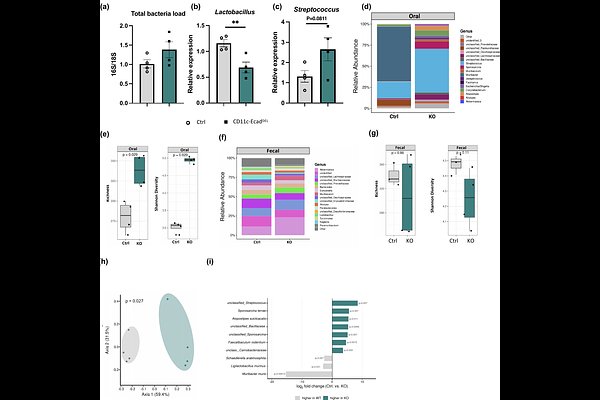
AbstractLangerhans cells (LC) are specialized antigen-presenting cells that form a dense immune surveillance network within the oral epithelium. There, they continuously interact with epithelial cells and the resident microbiota to maintain mucosal homeostasis. A defining feature of LC is their highly dendritic morphology, which enables efficient sampling of the environment at barrier surfaces. Although E-cadherin-mediated adhesion has been implicated in LC-epithelial cell interactions, its role in oral LC biology and periodontal immune homeostasis remains elusive. Here, we investigated the function of E-cadherin on oral LC using CD11c-specific E-cadherin-deficient (CD11c-EcadDEL) mice. Loss of E-cadherin profoundly altered LC morphology throughout the oral mucosa, resulting in reduced dendrite formation and impaired dendrite extension towards the epithelial surface, thereby disrupting interaction with the oral microbiota. While the total number of LC remained unchanged, E-cadherin deficiency significantly altered the relative distribution of LC subsets, characterized by reduced LC1 and increased LC2 populations. E-cadherin-deficiency was associated with pronounced oral dysbiosis, characterized by increased bacterial burden and microbial diversity, as well as a shift away from the commensal-dominated community, particularly through the loss of protective lactobacilli. Transcriptome analysis of gingival tissue revealed inflammatory reprogramming marked by enrichment of NF-kB, TNF, IL-17, Toll-like receptor, and MAPK signaling pathways. Consistently, CD11c-EcadDEL mice exhibited increased IL-17A production in the gingiva, expansion of ab and gd T cells, spontaneous age-dependent alveolar bone loss, and exacerbated inflammatory bone destruction in a model of ligature-induced periodontitis. In summary, our findings reveal that E-cadherin preserves oral LC dendrite organization and microbiota-dependent immune homeostasis, thereby limiting dysbiosis-driven inflammation and periodontal bone loss.