Unravelling the memory of the extracellular matrix using MASH-derived decellularized scaffolds

Unravelling the memory of the extracellular matrix using MASH-derived decellularized scaffolds
Pinto, G. R.; Braz, L. D. G.; Pestana, Y.; Filho, A. C. d. S.; Gomes, M. I. M. d. A. C.; de Barros, J. H. O.; de Oliveira, T. S.; Feng, I. Z. L. F.; Santana, B. F.; Carvalho, H. F.; Andrade, C. B. V.; Guarnier, L. P.; Amorim, E. A.; Pimentel, C. F.; Goes, A. M.; Leite, M. d. F.; Santos, R. A. S.; Alves, M. A.; Goldenberg, R. C. d. S.; Dias, M. L.
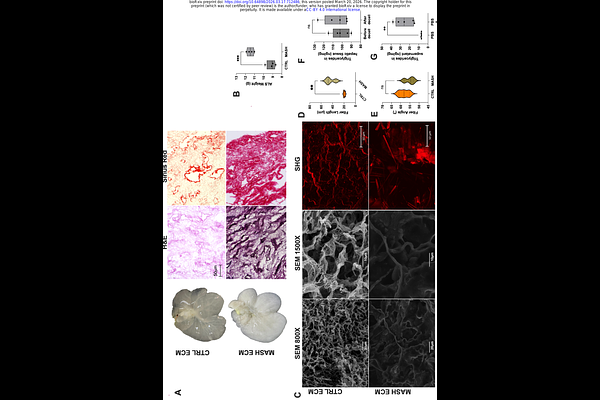
AbstractThe use of decellularized diseased livers in regenerative medicine is a promising approach for eliminating organ shortages. Bioengineering studies have shown that ECM can impact cell physiology, inducing cell activation, function, and ECM deposition, which suggests that the ECM has a memory that is involved in the outcome after recellularization. However, the effect of diseased ECM memory on new cells in vitro and in vivo has not been thoroughly investigated. Since it has been increasingly recognized that liver ECM changes due to different factors, it is comprehensively that diseased ECM obtained from discarded organs will ensure a distinct environment and impact cell survival and physiology. Thus, we aimed at investigating the impact of the memory of diseased ECM obtained from metabolic dysfunction-associated steatohepatitis (MASH)-derived organs on steatohepatitis establishment. To address this aim, we explored decellularized ECM obtained from rats and humans with MASH in different contexts. First, MASH ECM was characterized and then submitted to transplantation to investigate whether a MASH-derived ECM could be used as a scaffold for transplantation and to promote steatohepatitis features in control animals. Histological analysis revealed that the MASH-ECM was completely recellularized after transplantation in both control and MASH recipient rats. However, steatosis and fibrosis were observed in MASH ECM after transplantation in both groups. Molecular analysis showed that MASH ECM stimulates de novo lipogenesis and fibrosis 30 days after transplantation. Untargeted metabolomic analysis revealed that cells grown on MASH ECM had a similar metabolic profile, even when transplanted into healthy or MASH recipient rats. In addition, we observed that MASH ECM promoted impaired lipid oxidation and mitochondrial dysfunction when transplanted into healthy recipients. Altered lipid turnover and inflammatory signaling were observed in MASH ECM transplanted in MASH recipients. In vitro analysis revealed that MASH ECM induced lipid accumulation in HepG2 cells after 10 days of culture. Calcium signalling experiments obtained from HepG2 cells cultured in MASH ECM showed a lower response to ATP, a reduced calcium signalling amplitude, and a distinct response profile than that observed in healthy ECM. On the other hand, a diseased human-derived ECM could still provide an environment that allows cell development. Taken together, our data showed that MASH ECM impacts cell metabolism, promoting steatohepatitis maintenance. In conclusion, our data confirm that diseased ECM memory can impact cell physiology contributing to disease progression.