Dissecting the Scalar Cosmological Collider with the Cosmic Microwave Background

Dissecting the Scalar Cosmological Collider with the Cosmic Microwave Background
Oliver H. E. Philcox
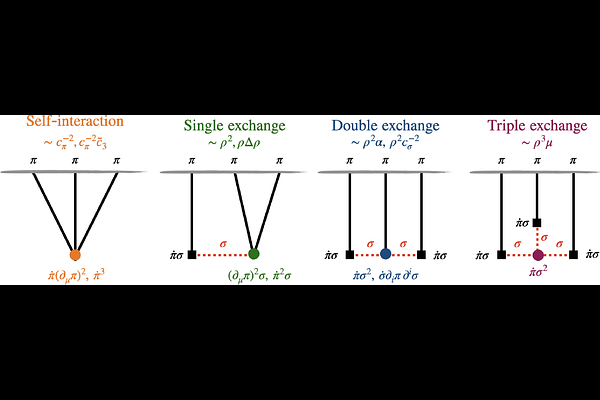
AbstractThe cosmological collider program probes ultra-high-energy physics by searching for subtle oscillatory signatures induced by inflationary particle exchange. Due to the non-linear symmetries usually assumed in inflation, these signals do not appear in isolation; moreover, their amplitudes are bounded by perturbativity and unitarity. To comprehensively probe cosmological collider physics, we must jointly analyze the full multi-field inflationary Lagrangian: in this work, we conduct such a study, probing single, double, and triple scalar field exchange and self-interactions across a wide range of masses (in both the complementary and principal series), mixings, and sound-speeds. Using modern theoretical tools (including the cosmological bootstrap and the cosmological flow), we construct a vast library of tree-level primordial bispectra: combining these with recent measurements of the inflationary shape function from Planck and modern sampling techniques, we perform Bayesian exploration of the eight-parameter multi-field likelihood. Most previous studies of cosmological collider physics assume weak mixing, such that the coupling between the scalar field and the Goldstone mode can be treated perturbatively: in our companion study, we demonstrate that this assumption is incompatible with current datasets except at the smallest masses. By solving for the inflationary bispectra numerically using CosmoFlow, we perform the first analysis of the strongly-mixed collider, demonstrating that the Planck constraints are much tighter than the theoretical bounds, though the oscillatory contributions are heavily suppressed. Across the full multi-field landscape, we find no evidence for new physics with a maximal $χ^2$ improvement of $5.3$.