Radiographic assessment of bone maturation as a tool for age estimation in common dolphins (Delphinus delphis)

Radiographic assessment of bone maturation as a tool for age estimation in common dolphins (Delphinus delphis)
Hanninger, E.-M. F. F.; Barratclough, A.; Betty, E. L.; Anderson, M. J.; Perrott, M. R.; Bowler, J.; Palmer, E. I.; Peters, K. J.; Stockin, K. A.
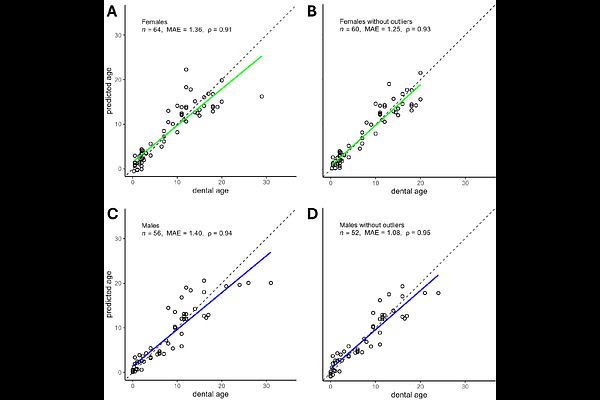
AbstractWe present the first radiographic ageing framework for common dolphins (Delphinus delphis), based on ossification and epiphyseal fusion patterns in the pectoral flipper, demonstrating higher reliability for chronological age estimation than currently available epigenetic approaches for this species. Using individuals of known dental age, we calibrated two modelling approaches to predict dental age from radiographic bone scores: 1) a univariate polynomial regression using a total bone score (sum of 16 scores across all assessed flipper bones), and 2) a multivariate canonical analysis of principal coordinates (CAP) incorporating 16 individual bone-score variables. Both approaches successfully predicted dental age from skeletal ossification patterns. For an age range of 0 to 24 years, polynomial regression demonstrated high predictive accuracy with median absolute errors (MAEs) of 1.25 years in females (Spearman's {rho} = 0.93, R2 = 0.90) and 1.08 years in males ({rho} = 0.95, R2 = 0.86). The CAP model yielded MAEs of 1.35 years in females ({rho} = 0.90, R2 = 0.85) and 1.80 years in males ({rho} = 0.94, R2 = 0.84). Notably, both radiographic bone ageing models achieved equal or lower median absolute errors and higher coefficients of determination than a recently developed epigenetic clock for common dolphins derived from the same population (MAE = 1.80, Pearson's correlation (r) = 0.91, R2 = 0.82). When applying the bone ageing models to individuals of unknown dental age, both models produced age estimates consistent with expected life-history stages (foetus, neonate, juvenile, subadult, adult), although accuracy declined in dolphins above 20 years, likely as a consequence of subtle age-related variation in skeletal changes in this species. Radiographic ageing provides an accurate non-invasive tool for demographic assessment to support conservation management of common dolphins.