Extreme Heat as the New Normal: A Methodological Roadmap for Behavior, Physiology, and Species Distributions

Extreme Heat as the New Normal: A Methodological Roadmap for Behavior, Physiology, and Species Distributions
Ellis Soto, D.; Noble, D. W. A.; Arnold, P. A.; Pottier, P.; Robey, A. J.; Prokopenko, C.; Cohen, J.
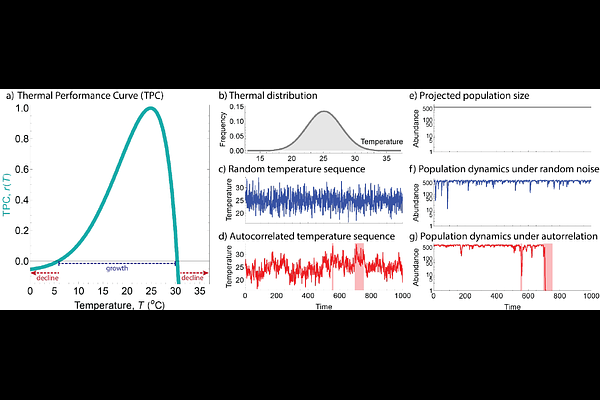
AbstractA defining feature of climate change is the increasing frequency, intensity, and severity of extreme weather events. Among them, extreme heat is recognized as a critical driver of ecological and evolutionary change. Intense heat episodes can exceed physiological limits, alter animal movement, restructure geographic ranges, and increase extinction risk more than gradual changes to mean temperatures. Yet links between extreme heat events and organismal biology remain limited, in part because definitions and metrics are not standardized, and user-friendly workflows and guides are lacking for many biologists. We present a methodological roadmap, with reproducible code, for integrating extreme heat into studies of behavior, physiology, biophysical ecology, species distribution models (SDMs), and population dynamics. First, we provide standardized computational approaches to define and quantify extreme heat. Second, we fit species distribution models for California quail (Callipepla californica) that include an extreme heat metric and showcase improved predictions of habitat suitability, particularly at range edges. Third, we compute biophysical simulations to quantify exposure to thermal stress in Sleepy lizards (Tiliqua rugosa) across distinct macro- and microclimates. Finally, accounting for temporal autocorrelation in temperature profiles in population simulation models, we show that clustered heat extremes--missed by averages--can increase the risk of population collapse. As extreme heat events become more common, incorporating their dynamics is essential for understanding ecological and evolutionary change, designing experiments across species' geographic ranges, and supporting conservation in a rapidly warming world. Together, these case studies illustrate a reproducible, organism-informed roadmap to integrate extreme heat into predictions of ecological impacts and inference across levels of biological organization under ongoing climate change.