Allocation pattern of fruiting bodies in plasmodial slime molds, and threshold size for sporulation of P. polycephalum

Allocation pattern of fruiting bodies in plasmodial slime molds, and threshold size for sporulation of P. polycephalum
Takahashi, S.; Nishigami, Y.; Taniguchi, A.; NAKAGAKI, T.
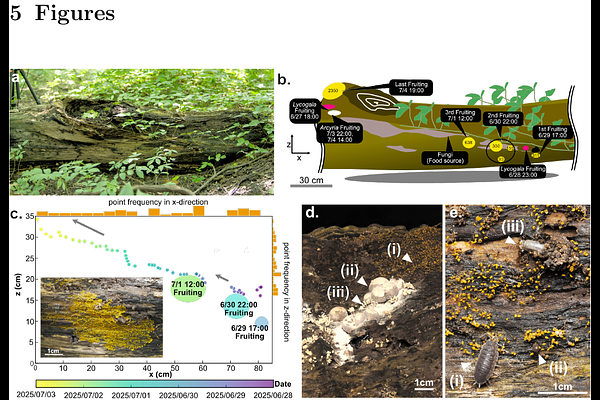
AbstractThe plasmodium of Myxogastoria (a group of amoeboid protists) species often crawls around the forest floor to feed while searching for places to form fruiting bodies for reproduction (sporulation). Certain environmental factors that trigger sporulation have been reported; however, other unknown factors are also expected. In this study, we reported field observations of Physarum rigidum and Fuligo septica. Inspired by the field observation, we examined the effects of multiple factors on sporulation in laboratory experiments using Physarum polycephalum. We found that:(1) there was a critical body size below which sporulation did not occur under our experimental conditions and (2) the plasmodium selected its sporulation sites from the available landscape of the experimental arena: dry and low sites for the majority and dry and high sites for the minority. Further analysis revealed that they preferred the edge area at the high site. We discuss the possible ecological importance of the threshold and location preference