SaNDi-SHoP: Searching for Satellites'N'Disks with a Star-Hopping Program II. Spectrophotometric analysis and orbital monitoring of directly imaged companions

SaNDi-SHoP: Searching for Satellites'N'Disks with a Star-Hopping Program II. Spectrophotometric analysis and orbital monitoring of directly imaged companions
Andrea Bernardi, Alice Zurlo, Cecilia Lazzoni, Silvano Desidera, Dino Mesa, Sebastian Pérez, Pedro Henrique Nogueira, Domenico Barbato, Anuroop Dasgupta
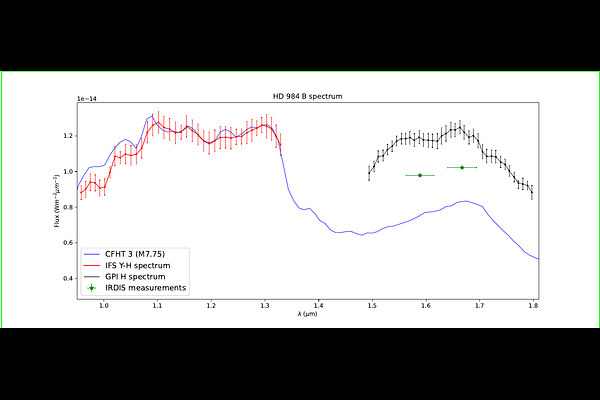
AbstractOver the past decade, advances in high-contrast imaging instrumentation, coupled with extreme adaptive optics systems, have enabled the discovery of tens of planets and brown dwarfs orbiting at wide separations from their host stars (a larger than 10 au). The existence of companions at these separations challenges current planet-formation paradigms, highlighting the importance of high-contrast imaging as the only technique capable of directly probing this region of planetary systems. In this paper, we present a survey of thirteen planets and brown dwarfs observed with VLT/SPHERE between June 2023 and July 2025. These data provide updated photometry in the 1.0-1.7 micron range and new high-precision astrometry, enabling tighter constraints on their orbital properties. We used the IRDIS subsystem to acquire dual-band H2H3 images (H2 = 1.593 microns, H3 = 1.667 microns) for all companions in our sample. For the three objects located within the IFS field of view (GQ Lup B, PZ Tel B, and HD 984 B), we additionally obtained low-resolution (R ~ 50) near-infrared (0.96-1.34 micron) spectra. We combined our new astrometric measurements with those available in the literature to derive updated orbital solutions. The orbital fitting was performed using the orbitize! Python package. For CT Cha b, HIP 78530 B, HIP 64892 B, and RX J1609.5-2105 b, this work provides the first orbital solutions to date. We derived new photometry for all objects, which, when compared with field dwarfs in color-magnitude diagrams, indicates spectral types ranging from mid-M to mid-L. For the companions observed with IFS, their spectra are best matched by those of M6-M8.5 field dwarfs. Our updated orbital fits provide tighter constraints for nearly all companions and are consistent with non-circular orbits in all cases, potentially disfavoring core-accretion formation within their circumstellar disks.