F10.7 Index Prediction: A Multiscale Decomposition Strategy with Wavelet Transform for Performance Optimization

F10.7 Index Prediction: A Multiscale Decomposition Strategy with Wavelet Transform for Performance Optimization
Xuran Ma, Xuebao Li, Yanfang Zheng, Yongshang Lv, Xiaojia Ji, Jiancheng Xu, Hongwei Ye, Zixian Wu, Shuainan Yan, Liang Dong, Zamri Zainal Abidin, Xusheng Huang, Shunhuang Zhang, Honglei Jin, Tarik Abdul Latef, Noraisyah Mohamed Shah, Mohamadariff Othman, Kamarul Ariffin Noordin
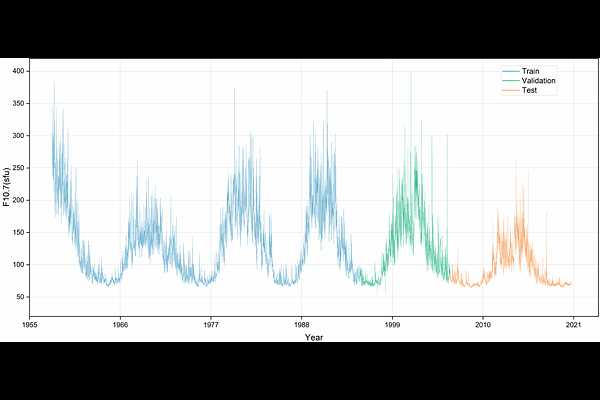
AbstractIn this study, we construct Dataset A for training, validation, and testing, and Dataset B to evaluate generalization. We propose a novel F10.7 index forecasting method using wavelet decomposition, which feeds F10.7 together with its decomposed approximate and detail signals into the iTransformer model. We also incorporate the International Sunspot Number (ISN) and its wavelet-decomposed signals to assess their influence on prediction performance. Our optimal method is then compared with the latest method from S. Yan et al. (2025) and three operational models (SWPC, BGS, CLS). Additionally, we transfer our method to the PatchTST model used in H. Ye et al. (2024) and compare our method with theirs on Dataset B. Key findings include: (1) The wavelet-based combination methods overall outperform the baseline using only F10.7 index. The prediction performance improves as higher-level approximate and detail signals are incrementally added. The Combination 6 method integrating F10.7 with its first to fifth level approximate and detail signals outperforms methods using only approximate or detail signals. (2) Incorporating ISN and its wavelet-decomposed signals does not enhance prediction performance. (3) The Combination 6 method significantly surpasses S. Yan et al. (2025) and three operational models, with RMSE, MAE, and MAPE reduced by 18.22%, 15.09%, and 8.57%, respectively, against the former method. It also excels across four different conditions of solar activity. (4) Our method demonstrates superior generalization and prediction capability over the method of H. Ye et al. (2024) across all forecast horizons. To our knowledge, this is the first application of wavelet decomposition in F10.7 prediction, substantially improving forecast performance.