The Architecture of the 14 Herculis System Suggests Primordial Ejection of a Massive Planet

The Architecture of the 14 Herculis System Suggests Primordial Ejection of a Massive Planet
Tiger Lu, Sarah C. Millholland, Malena Rice, Brennen Black, Daniella C. Bardalez Gagliuffi, William O. Balmer, Laurent Pueyo, Mark R. Giovinazzi, Timothy D. Brandt
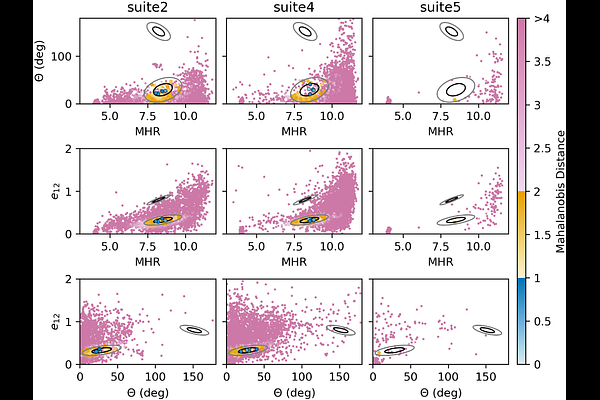
AbstractThe 14 Herculis system hosts two super-Jupiters on eccentric, significantly misaligned orbits. This orbital architecture represents a dynamical puzzle that demands explanation. In this work, we reproduce the system's dynamical history and current architecture using a large suite of N-body simulations of planet-planet scattering. Our results demonstrate that planet-planet scattering is able to reproduce 14 Her's peculiar orbital architecture, but only if additional massive bodies were initially present in the system that were subsequently ejected. The mass of any such ejected planet can in turn constrain the system's initial configuration. We also analyze the present-day secular evolution of the system and conclude that while there are most likely nontrivial eccentricity and inclination oscillations currently occurring, the magnitudes of these oscillations are not strong enough to allow tidal forces to meaningfully alter the system's architecture. Finally, we discuss how forthcoming observations from future Gaia data releases and the Roman mission may situate 14 Her's dynamical history within a broader, population-level framework.