Latitudinal chemical and cloud variations in the atmosphere of a brown dwarf

Latitudinal chemical and cloud variations in the atmosphere of a brown dwarf
Benjamin Charnay, Sam de Regt, Matthieu Ravet, Lucas Teinturier, Flavien Kiefer, Gaël Chauvin, Allan Denis, Mickaël Bonnefoy, Paulina Palma-Bifani, Alice Radcliffe, Arthur Vigan
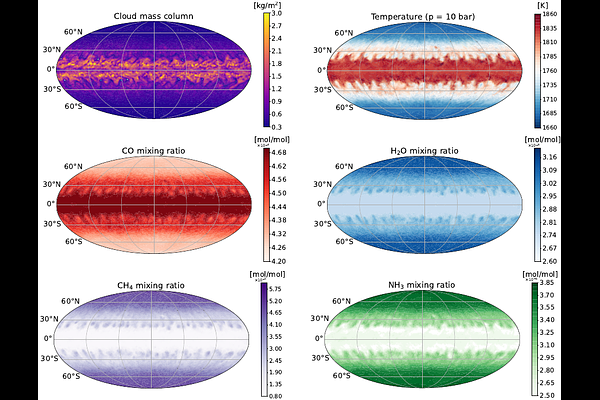
AbstractBrown dwarfs are massive analogues of extrasolar giant planets. Compared to exoplanets whose observations are generally limited by the presence of their bright host star, brown dwarfs are ideal targets for studying substellar atmospheric physics, chemistry and dynamics. Previous observations and simulations of their atmospheres suggest preferential cloud formation around the equator, associated with an equator-pole thermal gradient. Here we show that this atmospheric structure should induce latitudinal chemical variations detectable by the Doppler effect. We introduce a new method - Differential Molecular Rotational Broadening - which consists in comparing the apparent rotational broadening of individual molecules from high-resolution spectra. Application of this approach to VLT-CRIRES observations for different molecules (CO, H2O, CH4 and NH3) in the atmosphere of the brown dwarf DENIS J0255-4700 confirms the existence of latitudinal chemical variations. Our data suggest a depletion of CH4 and NH3 at low latitudes, consistent with an equatorial cloud belt. Our method could be applied to multiple brown dwarfs and exoplanets to map their atmospheres and to study various atmospheric processes.