Imaging-Based Age- and Sex-specific Cardiovascular and Skeletal Phenotypes in Fbn1C1041G/+ Mice

Imaging-Based Age- and Sex-specific Cardiovascular and Skeletal Phenotypes in Fbn1C1041G/+ Mice
Liu, W.; Li, S.; Zhang, X.; Su, L.; Lin, H.; Li, P.; Liu, J.; Niu, Y.; Li, S.
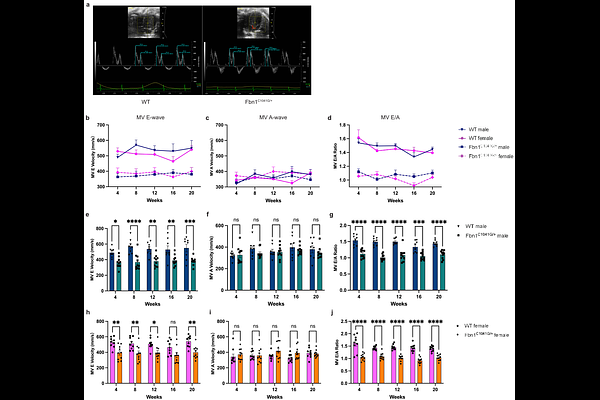
AbstractMarfan syndrome is a multisystem connective tissue disorder with age-dependent and sex-dependent phenotypic variability. This study characterized early cardiovascular, valvular, transmitral flow, and skeletal changes in Fbn1C1041G/+ mice. Male and female wild-type and Fbn1C1041G/+ mice were examined from 4 to 20 weeks of age. Transthoracic echocardiography was used to measure aortic root and ascending aortic diameters, anterior mitral leaflet length, and mitral inflow Doppler parameters. Lateral X-ray imaging was used to quantify kyphosis angle. Fbn1C1041G/+ mice of both sexes developed progressive aortic dilation, with earlier and broader aortic root involvement in males and delayed annular dilation in females. Anterior mitral leaflet elongation was detected from 8 weeks in males and at 20 weeks in females. In contrast, reduced E-wave velocity and E/A ratio were present from 4 weeks in both sexes, without changes in A-wave velocity. Kyphosis was detectable earlier in females than in males. These findings show that early Fbn1-related phenotypes follow organ-specific and sex-dependent temporal patterns, supporting age-resolved and sex-stratified assessment in preclinical Marfan syndrome studies.