ID-MAGE II: The Star Forming Satellites of Low-Mass Hosts

ID-MAGE II: The Star Forming Satellites of Low-Mass Hosts
Laura Congreve Hunter, Burçin Mutlu-Pakdil, Michael B. Farnell, David J. Sand, Paul Bennet, Sasha N. Campana, Jeffrey L. Carlin, Denija Crnojević, Amandine Doliva-Dolinsky, Emmanuel Durodola, Michael G. Jones, Donghyeon J. Khim, Laurella Marin, Ricardo J. Mendez, Deepthi S. Prabhu, Kristine Spekkens, Dennis Zaritsky
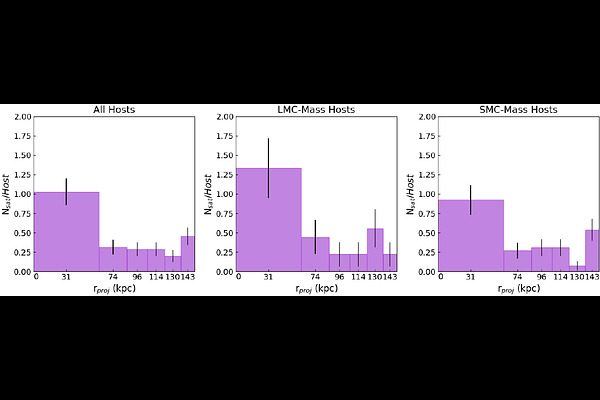
AbstractWe present results from our ongoing campaign to follow up the satellite candidates from the Identifying Dwarfs of MC Analog GalaxiEs (ID-MAGE) survey. Previously, we published a list of 355 unresolved satellite candidates identified around 36~nearby LMC- and SMC-mass hosts (D$=$4$-$10~Mpc). We present the velocities of 83 satellite candidates from new Green Bank Telescope \hi\ observations, optical long-slit spectra, and the Dark Energy Survey Instrument Data Release 1. Based on their velocities, we identify six candidates as probable satellite galaxies ($6.5\times10^5\leq M_\star/M_\odot\leq1.5\times10^7$) and 77 as background galaxies. Our results underscore the ability of spectroscopic follow-up to effectively separate satellites from background galaxies. Using the refined sample, we update our previously derived estimates for the average satellite population per host and find 1.7$\pm$0.7 (1.0$\pm$0.3) satellites per LMC-mass (SMC-mass) host. Our current satellite sample includes 25 galaxies confirmed by distances or velocities. This set includes the complete satellite populations of three hosts (UGC~04422: zero satellites, UGC~08201: zero satellites, NGC~3432: four satellites), which we compare to simulations and known satellite systems from the literature. Our sample is nearly complete for the most massive satellites (M$_\star > 10^7~M_\odot$). We find these massive satellites have a quenched fraction of 10--25\%, placing them between the $<$5\% quenched fraction of isolated galaxies and the 40--70\% quenched fraction of MW-analog satellites with $10^7~M_\odot < $ M$_\star < 10^8~M_\odot$. This demonstrates the impact that low-mass galaxies have on the evolution of their satellites.