Uncertainty-aware breeding decisions: MCMC-based optimum contribution selection increases breeding decision robustness

Uncertainty-aware breeding decisions: MCMC-based optimum contribution selection increases breeding decision robustness
Ahlinder, J.; Waldmann, P.
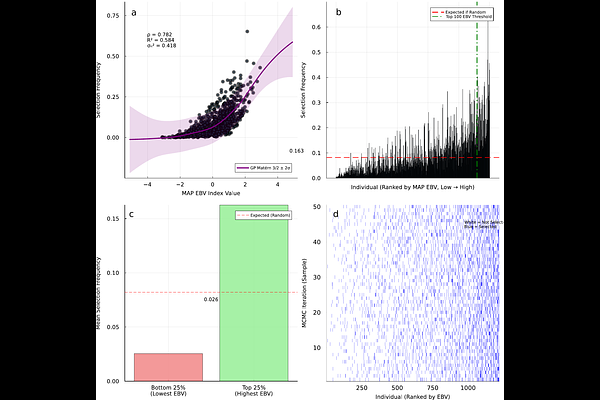
AbstractCurrent optimum contribution selection (OCS) implementations use point estimates of estimated breeding values (EBVs), potentially leading to suboptimal selections when individuals have uncertain genetic evaluations. We developed a framework assessing how EBV uncertainty affects OCS decisions through MCMC-based approaches using the COSMO optimizer in Julia, evaluated on Norway spruce (Picea abies, n=5,525) and Loblolly pine (Pinus taeda, n=926) populations. Agreement between point estimate (MAP-OCS) and MCMC-OCS was surprisingly low: mean overlap of only 26.6 (4.8) individuals in Norway spruce genotyped subpopulation and 14.1 (3.6) in full pedigree, with Loblolly pine intermediate at 16.0 (9.6). Despite this low individual-level agreement, selection frequency across MCMC iterations corresponded well with EBV rankings (Spearman = 0.782 for Norway spruce), confirming that higher-EBV individuals were preferentially selected under posterior uncertainty. To comprehensively quantify uncertainty impacts, we employed two complementary metrics: individual robustness scores measuring genetic gain stability upon candidate removal, and population-level contribution distribution metrics capturing concentration of genetic gain across selected individuals. Applying these metrics identified 25 high-risk individuals in Norway spruce and nine in Loblolly pine, and constrained exclusion of these individuals improved individual robustness by 16.5% in Loblolly pine (3.00% genetic gain loss) and 29.8% in Norway spruce (2.14% genetic gain loss). Our uncertainty-aware OCS framework successfully identifies unstable selections that may compromise long-term genetic gain, and we recommend assessing EBV uncertainty through posterior distributions and evaluating population-specific trade-offs when implementing uncertainty-aware selection strategies.