Genetic coupling of hydathode formation with leaf morphogenesis maintains water homeostasis

Genetic coupling of hydathode formation with leaf morphogenesis maintains water homeostasis
Savourat, P.; Sarthou, A.-S.; Papadopoulos, P.; Vasselon, D.; Olympio, A.; Borrega, N.; Pateyron, S.; Paysant Le Roux, C.; Quentin, C.; Genty, B.; NOEL, L. D.; Routaboul, J.-M.; Leonhardt, N.; Laufs, P.
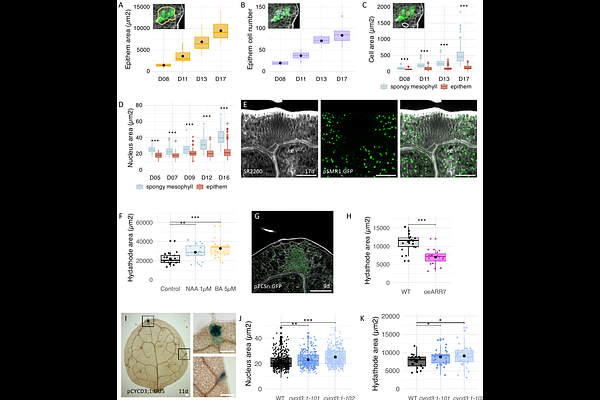
AbstractHydathodes are specialized leaf structures present across vascular plants that allow guttation by connecting the xylem to the external environment through epithem tissue and permanently open water pores. However, the genetic mechanisms controlling their formation and physiological roles remain poorly understood. Here, we identify a genetic regulatory network that controls hydathode formation and links this process to leaf morphogenesis. This network converges on auxin signaling to coordinate the formation of the three hydathode cell types. We further show that epithem development requires sustained cell proliferation with limited endoreduplication. Analysis of hydathode mutants demonstrates that hydathode size and number are required to prevent reversible leaf flooding. Together, these findings establish a genetic framework for hydathode morphogenesis and uncover a central role for hydathodes in maintaining leaf water homeostasis under fluctuating environmental conditions.