LLM-autonomous development of deep learning models for quantitative microscopy

LLM-autonomous development of deep learning models for quantitative microscopy
Zhou, X.; Wang, S.
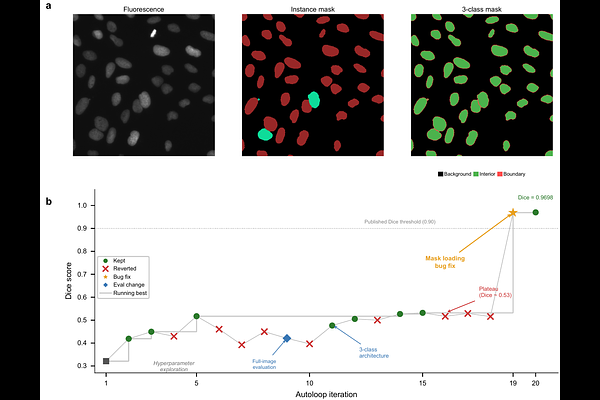
AbstractDeep learning can extract quantitative measurements from microscopy images that are inaccessible to classical analysis, but developing these models requires machine learning expertise that most imaging scientists do not have. Here we present a framework in which a researcher describes their microscopy problem to a large language model (LLM) agent in under ten minutes of conversation---specifying what they image, what they want to measure, and what success looks like---and the agent autonomously handles the rest: designing physics-based training data, implementing a neural network, training, diagnosing failures, and iterating without human intervention. A researcher can start the agent before leaving the lab; overnight, it tests tens to a hundred model variations, each one an experiment that would otherwise demand active attention. We validate the framework across six microscopy modalities and four problem types. On the BBBC039 nuclear segmentation benchmark, the agent autonomously trains a U-Net with 3-class semantic segmentation and morphological post-processing, achieving pixel-level Dice of 0.97 and object-level F1 of 0.84---within 7% of the published baseline---while diagnosing a data pipeline bug that no amount of hyperparameter tuning could resolve. On single-protein holographic microscopy, the agent reads a published paper, designs a simulator, and develops an optimized model in a single session. On PatchCamelyon histopathology classification, the agent autonomously evolves through four optimization phases---from scratch training through transfer learning and regularization to inference-time ensembling---completing 97 iterations on 262,144 images to reach 89.3% test accuracy and 96.3% AUC, nearly matching the published rotation-equivariant baseline. This framework enables microscopy researchers to use deep learning-based image analysis without machine learning domain knowledge.