Hyperspectral Remote Sensing for Harmful Algal Bloom Detection: Pseudo-nitzschia in the Northeast Pacific

Hyperspectral Remote Sensing for Harmful Algal Bloom Detection: Pseudo-nitzschia in the Northeast Pacific
Bailess, A.; Baetge, N.; Barnard, A.; Tufillaro, N.; Behrenfeld, M.; Bill, B.; Kudela, R.; Graff, J.; Kavanaugh, M.
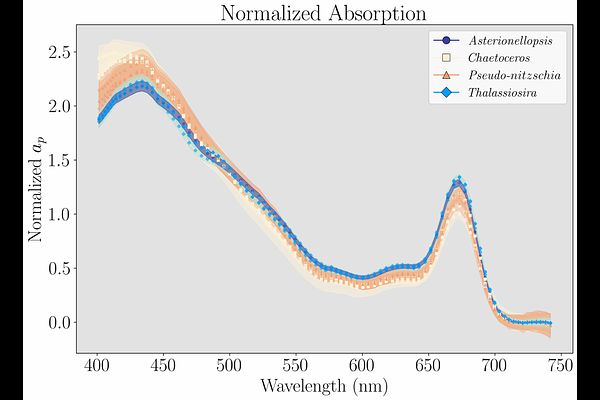
AbstractDiatoms are microscopic marine algae that are critical for global primary production, carbon sequestration, and fisheries productivity. However, select diatoms may form harmful algal blooms, which threaten marine ecosystems and the fisheries they sustain. Rapidly identifying harmful blooms is necessary to effectively manage marine resources, yet current identification methods are limited by expensive and labor-intensive in situ point sampling. Hyperspectral remote sensing enables scalable monitoring, but its ability to resolve taxonomic shifts within phytoplankton groups (e.g. diatoms) is largely unknown. To investigate this uncertainty, we cultured four dominant diatom genera from the California Current upwelling system, including this systems' most abundant harmful algae, Pseudo-nitzschia. The hyperspectral absorption and backscatter of these taxa were measured and used to model spectral reflectances that remote sensing platforms (satellites/drones) might detect. Differences between fingerprints of these taxa were quantified using vector-based and statistical analyses. Mean spectral differences of 48% were observed between the most dominant diatom, Thalassiosira, and the most toxic diatom, Pseudo-nitzschia. Differences of approximately 30% were found between Pseudo-nitzschia and the second and third most abundant diatoms, Chaetoceros and Asterionellopsis. Successful identification of Pseudo-nitzschia's reflectance fingerprint was driven by the presence of a unique feature around 560 nm. The distinct spectral fingerprint of Pseudo-nitzschia indicates that it can be distinguished from benign diatom blooms using hyperspectral remote sensing platforms.