MxGPS: Multiplex Graph Transformers for a Power Grid Foundation Model

MxGPS: Multiplex Graph Transformers for a Power Grid Foundation Model
Charilaos Papaioannou, Ioannis Tsantilas, Dimitris Giannakakos, Vasilis Michalakopoulos, Sotiris Pelekis, Vangelis Marinakis, Arsam Aryandoust, Antonello Monti, Ricardo J. Bessa, Perdo P. Vergara, Jochen Cremer, Elissaios Sarmas
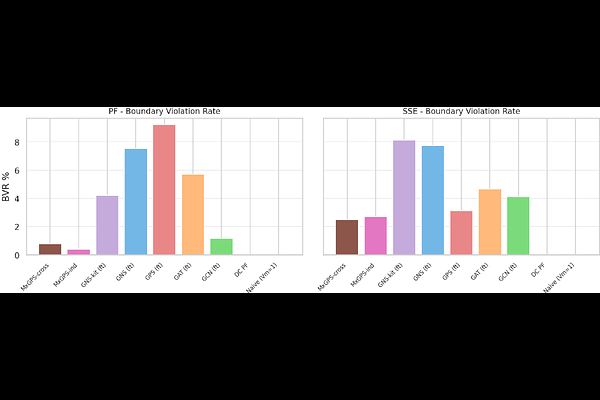
AbstractSingle-task fine-tuning of graph neural networks (GNNs) for power grid problems exhibits a systematic failure mode: models that achieve the lowest in-distribution error degrade the most under topology shift. We term this topology overfitting: the tendency of task-specific gradient signals to encode relational structure particular to the training topologies rather than the underlying physics, causing models to fail on unseen grids despite strong in-distribution performance. To expose and address this failure mode, we introduce MxGPS (Multiplex GPS), a multiplex graph transformer that runs K task-specialised GPS branches over a shared node encoder, jointly trained on Static State Estimation (SSE) and AC Power Flow (PF) via a self-supervised pre-training and multi-task fine-tuning protocol, with a cross-branch attention module evaluated in ablation. The joint SSE+PF objective forces the shared encoder to simultaneously satisfy complementary gradient signals, preventing it from overfitting to topology-specific relational structure. Under a 3-fold sliding-window cross-validation spanning four unseen topologies (14-, 24-, 162-, and 300-bus), MxGPS attains 0% boundary violation rate (BVR) on all four zero-shot Power Flow topologies. Critically, models with substantially lower in-distribution PF error degrade by 190% to 1400% under topology shift, whereas MxGPS degrades by only 39%, an inversion that directly implicates topology overfitting as the failure mechanism rather than insufficient model capacity. With only 1.6M parameters (12x fewer than the GridFM reference baseline), MxGPS demonstrates that multi-task joint training is a principled and parameter-efficient mechanism for topology-agnostic generalisation in power grid foundation models.