Prophage {Phi}ESI promotes competitive dominance in the emergent Salmonella serovar Infantis lineage

Prophage {Phi}ESI promotes competitive dominance in the emergent Salmonella serovar Infantis lineage
Martinez-Padilla, C.; Tichy-Navarro, D.; Barron-Montenegro, R.; Herrera-Vergini, I.; Ugalde, J. A.; Alvarez-Espejo, D.; Moreno-Switt, A. I.; Pina-Iturbe, A.
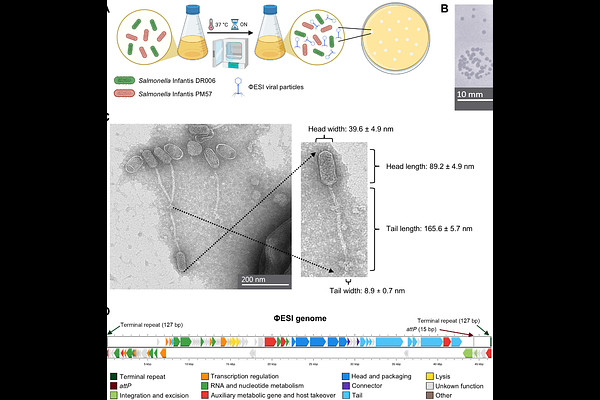
AbstractThe global spread of multidrug-resistant Salmonella enterica serovar Infantis has been largely attributed to the pESI megaplasmid, yet additional factors underlying the ecological success of this lineage remain unclear. Here, we characterize {Phi}ESI (phage of emergent Salmonella Infantis), a temperate bacteriophage discovered during coculture of an emergent pESI-positive strain (PM57) and a non-emergent strain (DR006). Phage {Phi}ESI shows a siphovirus morphotype with a long tail and an elongated head, with a genome of 46,490 bp, which is integrated as a prophage in the 3'-end of an Arg-tRNA gene in PM57, but is absent in DR006, which is susceptible to the {Phi}ESI-mediated lysis. The screening of {Phi}ESI genes across 20,429 global Salmonella Infantis genomes revealed an almost exclusive association of {Phi}ESI and {Phi}ESI-like phages with the emergent pESI-positive Salmonella Infantis lineage. Further bioinformatic analyses of complete chromosomes revealed diverse {Phi}ESI insertion profiles showing geographic clustering, and the presence of large-scale chromosomal inversions flanked by {Phi}ESI genes. Competition assays showed that PM57 outcompeted DR006 in coculture, coinciding with high viral loads that selectively targeted DR006, and susceptibility assays showed that strains lacking {Phi}ESI/{Phi}ESI-like prophages were susceptible to {Phi}ESI-mediated lysis. Together, our findings identify {Phi}ESI as a competitive factor associated with emergent Salmonella Infantis, able to selectively eliminate susceptible competitors. Our findings suggest that {Phi}ESI/{Phi}ESI-like prophages contributed to the persistence and global dissemination of the emergent Salmonella Infantis lineage.