Structural basis of biofilm formation mediated by the Pseudomonas aeruginosa fibrillar adhesin CdrA

Structural basis of biofilm formation mediated by the Pseudomonas aeruginosa fibrillar adhesin CdrA
Smith, O. E. R.; Clemente, C. M.; Andreeva, A.; Wang, Z.; Weimann, A.; Dinan, A. M.; Houghton-Flory, C.; Tarafder, A. K.; Boehning, J.; O'Toole, G. A.; Floto, R. A.; Mobarec, J.-C.; Bateman, A.; Bharat, T.
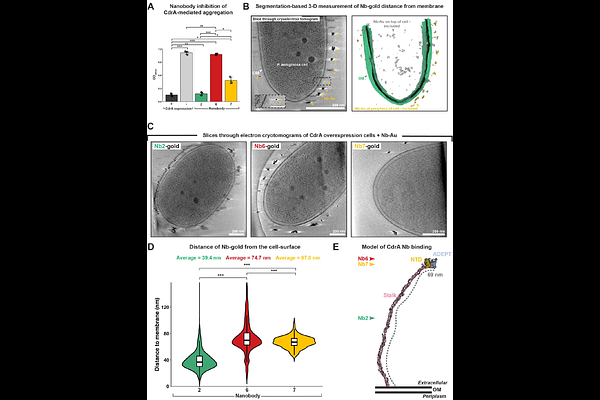
AbstractMany bacteria, including the important human pathogen Pseudomonas aeruginosa, are naturally found in antibiotic-tolerant, multicellular biofilms. Cell-cell interactions within P. aeruginosa biofilms are mediated by a large fibrillar adhesin called CdrA in an extracellular polysaccharide-dependent manner. Here, we report an electron cryomicroscopy structure of the 60 kDa CdrA adhesive N-terminus, which combined with electron cryotomography of focused-ion beam milled specimens, allows us to derive a complete in situ model of the native adhesin. Our structure reveals a small adhesive domain (called ADEPT) at the distal tip of CdrA that is nearly perfectly conserved across the P. aeruginosa pangenome, with structural similarity to previously reported sugar-binding domains in multiple bacterial species. Inhibitory nanobodies targeting CdrA that reduce biofilm formation bind to epitopes in, or close to, the ADEPT on bacterial cells. Furthermore, structure-guided mutagenesis of residues within the ADEPT abolishes bacterial aggregation, and genomic deletion of the whole ADEPT leads to strong attenuation of biofilm formation. Our data forms a rational basis for future targeted inhibition of pathogenic P. aeruginosa biofilms and elucidates the mechanism of biofilm formation mediated by fibrillar adhesins that are widespread in bacteria.