JWST Lensed Quasar Dark Matter Survey V: Measuring the minimum halo mass with strong gravitational lensing

JWST Lensed Quasar Dark Matter Survey V: Measuring the minimum halo mass with strong gravitational lensing
A. M. Nierenberg, D. Gilman, T. Treu, X. Du, C. Gannon, H. Paugnat, S. Birrer, A. J. Benson, K. N. Abazajian, T. Anguita, S. G. Djorgovski, S. F. Hoenig, R. E. Keeley, A. Kusenko, H. R. Larsson, L. A. Moustakas, P. Mozumdar, W. Sheu, D. Sluse, D. Stern, D. Williams, K. C. Wong
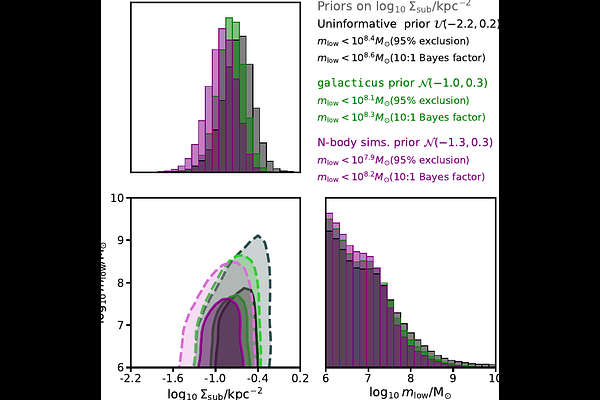
AbstractWe explore the lowest mass limit that can be placed on the halo mass function in CDM using 28 strong gravitational lenses. For this purpose, we study an extreme model in which the halo mass function and mass-concentration relation follow CDM, with a sharp cutoff at some mass scale, $m_{\rm{low}}$. Lensing provides a unique window into this quantity as it does not depend on the presence of baryons in dark matter halos and also allows the detection of low mass halos at cosmological distances, both in the lens galaxies and along the line-of-sight. Our model incorporates the effects of tidal stripping of subhalos, leading to the presence of many subhalos below a given model cutoff scale. We place an upper limit on the low-mass cutoff of the halo mass function of $m_{\rm{low}}<10^{8.3}$ M$_\odot$ at 10:1 odds using a prior for the normalization of the subhalo mass function from the semi-analytic model {\tt galacticus} and $m_{\rm{low}}<10^{8.2}$ M$_\odot$ at 10:1 odds using a prior from $N$-body simulations. These limits are comparable to, or stronger than, existing constraints based on Milky Way satellite galaxies. Based on these results, we forecast more than an order of magnitude improvement with a sample of 200 quadruply imaged quasar lenses. This number represents a small subset of the thousands that are anticipated to be discovered by Rubin, Euclid, and Roman. Furthermore, with this larger sample of lenses we expect to directly constrain the normalization of the subhalo mass function, thereby eliminating a major source of uncertainty in our current measurements.