Loopholing All the Way: Language Modeling with pure Self-Conditioning

Loopholing All the Way: Language Modeling with pure Self-Conditioning
Adrien Deschenaux, Nadezhda Ilieva, Justin Deschenaux, Manuel Madeira, Dorina Thanou, Aurélien Lucchi, Antonio Orvieto, Caglar Gulcehre, Pascal Frossard
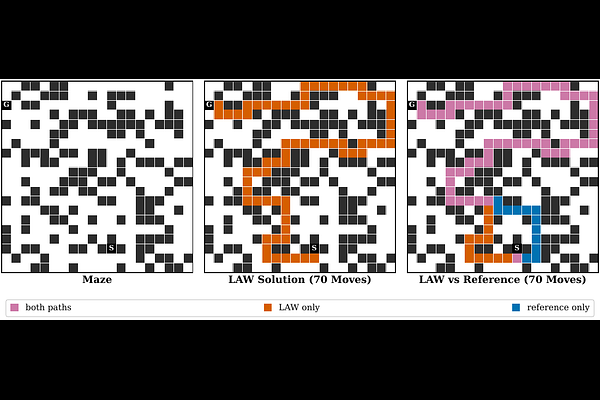
AbstractRecent Diffusion Language Models (DLMs) use Self-Conditioning (SC), or Loopholing, to improve their performance. While SC is traditionally seen as an auxiliary heuristic, its empirical success raises the question: can a continuous generative model be based purely on Self-Conditioning? We answer affirmatively with LAW (``Loopholing All the Way''), which propagates the Expected Embedding under the denoiser's prediction across steps, decoding the tokens once, at the end. On Sudoku, LAW outperforms previous Discrete and Continuous Diffusion Models, including Loopholing Discrete Diffusion. On Maze, LAW is the most accurate from 2 to 64 NFE. After training on TinyGSM and sampling at temperature 1 with 1024 NFE, LAW solves 42.2% of GSM8K problems against 34.5% for uniform Loopholing Discrete Diffusion. Additionally, fine-tuning a pre-trained Uniform Diffusion Model (Duo) with LAW increases its accuracy from 17.2% to 48.1%. Finally, on OpenWebText, LAW pushes the Pareto frontier and approaches Autoregressive Models (ARMs) with 64 NFE. Find our code at https://github.com/ilievanadezhda/law.