A Method for Thermal Radiation Transport Using Backward Characteristic Tracing

A Method for Thermal Radiation Transport Using Backward Characteristic Tracing
J. C. Dolence, H. R. Hammer, H. Park, B. Prather, B. R. Ryan, R. T. Wollaeger
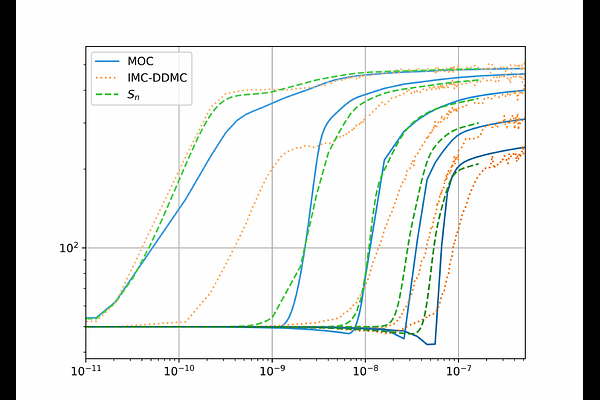
AbstractThermal radiation transport is a challenging problem in computational physics that has long been approached primarily in one of a few standard ways: approximate moment methods (for instance P$_1$ or M$_1$), implicit Monte Carlo, discrete ordinates, and long characteristics. In this work we consider the efficacy of the Method of (Long) Characteristics (MOC) applied to thermal radiation transport. Along the way we develop three major ideas: transporting MOC particles backwards in time from quadrature grids at the end of the timestep, limiting the computational cost of these backward characteristics by terminating transport once optical depths along rays become sufficiently large, and timestep-dependent closures with multigroup MOC solutions for a gray low-order system. We apply this method to a suite of standard radiation transport and radiation hydrodynamics test problems. We compare the method to several standard analytic and semi-analytic solutions, as well as implicit Monte Carlo, P$_1$, and discrete ordinates (S$_n$). We see that the method: gives excellent agreement with known results, has stability for large time steps, has the diffusion limit for large spatial cells, and achieves $\sim$20-70\% performance improvement when terminating optical depths at O(10-100) in the grey Marshak and crooked pipe problems. However, for the Coax radiation-hydrodynamics problem, we see that MOC is approximately two to three times slower than IMC-DDMC and S$_n$ in its current implementation.