A High-Likelihood Polar Interstellar Meteor Candidate

A High-Likelihood Polar Interstellar Meteor Candidate
Richard Cloete, Abraham Loeb
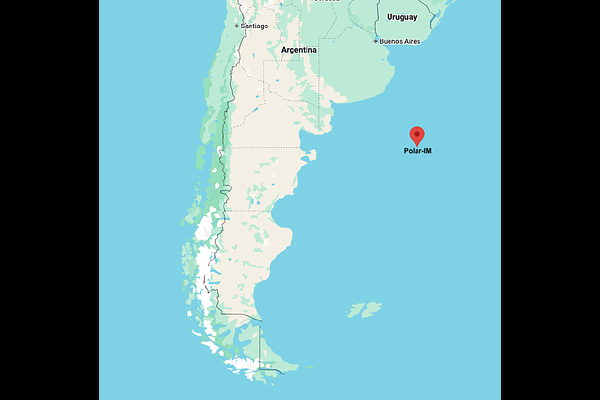
AbstractWe report a newly identified polar interstellar meteor candidate, labeled polarIM, detected on 2026-04-01 02:13:14 UTC at latitude $-41.9^\circ$, longitude $-54.7^\circ$, and altitude 90.5 km over the South Atlantic Ocean, east of Argentina. We transform the reported Earth-fixed velocity vector $(+3.6,\,-34.6,\,+59.8)~\mathrm{km\,s^{-1}}$ to an inertial geocentric state, remove Earth's gravitational acceleration with a two-body hyperbolic model, add the JPL Horizons heliocentric velocity of Earth, and test the resulting heliocentric orbit against solar escape speed. The final velocity component in the polar ($z$) direction of $+47.09~\mathrm{km\,s^{-1}}$ exceeds by itself the local solar escape speed $v_{\rm esc,\odot}=42.14~\mathrm{km\,s^{-1}}$. The full heliocentric speed is $v_{\rm hel}=51.73~\mathrm{km\,s^{-1}}$, corresponding to positive heliocentric specific energy $\varepsilon_\odot=+450.1~\mathrm{km^2\,s^{-2}}$, heliocentric excess speed $v_{\infty,\odot}=30.00~\mathrm{km\,s^{-1}}$, and a two-body inclination $i=89.4^\circ$. We propagate measurement uncertainty through 1,000,000 Monte Carlo realizations using the empirical post-2018 low-discrepancy CNEOS error model of Pena-Asensio et al. (2025), with $σ_v=0.55~\mathrm{km\,s^{-1}}$, $σ_{\rm RA}=1.35^\circ$, and $σ_{\rm Dec}=0.84^\circ$. No realization yields a bound heliocentric orbit, giving a statistical confidence on the interstellar fraction of $>99.9997\%$. The Monte Carlo margin above escape is $\langleΔ\rangle=9.60\pm0.75~\mathrm{km\,s^{-1}}$, corresponding to a $12.82σ$ margin-to-scatter ratio under the adopted perturbation model. The result identifies polarIM as the highest-margin post-2018 candidate in the CNEOS catalog.