GPS constellation search for exotic physics messengers coincident with the binary neutron star merger GW170817

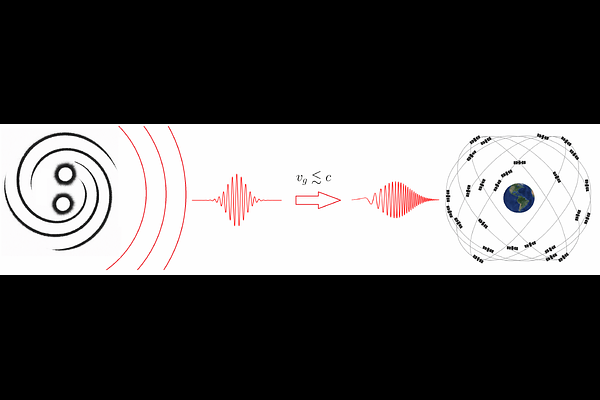
GPS constellation search for exotic physics messengers coincident with the binary neutron star merger GW170817
Arko P. Sen, Geoffrey Blewitt, Andrey Sarantsev, Paul Ries, Andrei Derevianko
AbstractThe Global Positioning System (GPS) includes a continuously operating, planet-scale network of atomic clocks that, beyond navigation and time dissemination, enables precision tests of fundamental physics. Here we use GPS carrier phase archival data to perform a retrospective search for exotic low-mass fields (ELFs) that might be emitted by the binary neutron-star merger GW170817, complementing gravitational wave and electromagnetic modalitiesnin multi-messenger astronomy. Such ultra-relativistic fields would imprint a dispersive, anti-chirp signature in clock-frequency time series, delayed with respect to the LIGO-Virgo gravitational wave detection. We construct network-median pseudo-frequency data from eighteen Rb satellite clocks referenced to a terrestrial hydrogen maser and conduct a template-bank search spanning ELF pulse duration, arrival delay, and characteristic frequency. No statistically significant signal is observed after accounting for noise statistics and template-bank trials. We derive 95\% confidence-level lower bounds on the interaction energy scale $Λ_α$ of quadratic couplings driving variations in electromagnetic fine-structure constant. These limits improve upon existing astrophysical and gravity-test constraints across the ELF-energy range $\approx10^{-18}$--$10^{-14}\,\mathrm{eV}$. This demonstrates that mature global satellite-clock networks provide an observational capability for retrospective, multi-messenger searches for new physics using decades of archival timing data.