Chromosomal rearrangements 1 and sequence similarity drivepreferential allosyndetic introgression from a wild relative into wheat

Chromosomal rearrangements 1 and sequence similarity drivepreferential allosyndetic introgression from a wild relative into wheat
Ye, H.; Zhang, Q.; Chotewutmontri, P.; Mandal, S. N.; Niu, Z.; Long, Y.; Shen, J.; Whetten, R. B.; Li, G.; Jin, Y.; Gale, S.; Friesen, T. L.; Peters Haugrud, A.; Xu, X.; Faris, J.; Yang, S.; Cowger, C.; Chen, J.; Cai, X.; Zhang, X.; Luan, S.; Gu, Y.; Klindworth, D. L.; Xu, S. S.
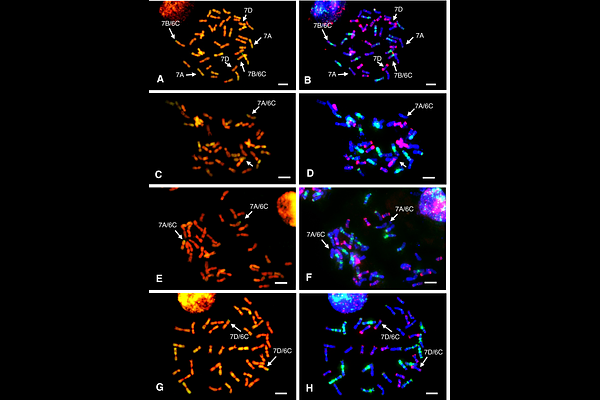
AbstractRecombination in polyploid genomes is generally constrained to homologous or homoeologous chromosomes; however, how chromosomal rearrangements influence recombination between chromosomes remains unclear. Here, we demonstrate that large-scale chromosomal rearrangements in the wild relatives of wheat are associated with recombination involving non-homoeologous chromosomes or arms during alien gene introgression under conditions that permit homoeologous recombination mediated by ph1b. Using a wheat chromosome 6A monosomic-induced 6AS/6CL Robertsonian translocation combined with ph1b-mediated recombination, we generated 17 independent recombinants carrying a new stem rust resistance gene, Sr69, from Aegilops caudata chromosome arm 6CL. Unexpectedly, 94.1% (16 of 17) of recombinants resulted from exchanges with wheat group-7 chromosomes rather than with the homoeologous group-6 chromosome. Comparative sequence- and marker-based analyses identified a 67-Mb rearranged interval on Ae. caudata 6CL that corresponds to telomeric regions of the long arms of wheat group-7 chromosomes. Sequence similarity within this interval was quantitatively associated with recombination frequency, with higher similarity corresponding to more frequent translocations. Physical and optical mapping showed that recombination within the rearranged interval generated compensating 7A/6C, 7B/6C, and 7D/6C translocations, whereas recombination outside this region produced non-compensating 6A/6C exchanges. An independent case involving the powdery mildew resistance gene Pm7C showed a similar correspondence between a rearranged 7CL region and preferential introgression into wheat 7DS. Together, these results indicate that ph1b-mediated recombination involving structurally altered chromosomes is driven by local chromosomal structure and sequence similarity rather than strict homoeologous group identity. This provides a mechanistic basis for harnessing untapped beneficial genes from structurally rearranged alien genomes.