Enhancing Fast Radio Transient Detection with Mask R-CNN Image Segmentation

Enhancing Fast Radio Transient Detection with Mask R-CNN Image Segmentation
Sergio Belmonte Diaz, Rene P. Breton, Zafiirah Hosenie, Ben W. Stappers
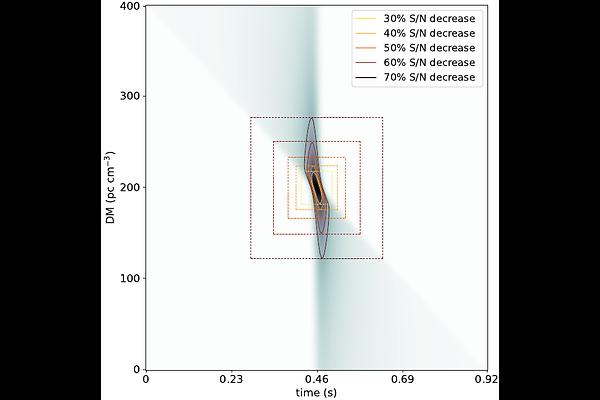
AbstractTraditionally, fast radio transient searches are conducted on dedispersed time series using thresholding techniques based on the statistical properties of the data. However, peaks in dedispersed time series do not directly provide information on the nature of the source. In the DM-time domain, the S/N variation of real, dispersed astrophysical signals forms a characteristic bow tie shape, whereas radio frequency interference (RFI) can take multiple different forms. We have developed a method that bypasses the thresholding step of traditional single-pulse searches in favour of a direct DM-time domain image analysis. The backbone of our pipeline is a Mask R-CNN, a deep learning model designed for object detection, enabling it to identify the bow tie signature and distinguish real sources from RFI. Previous deep learning models often include a snippet of the DM-time domain in their input. We have trained the model on simulated bursts injected on top of real MeerKAT noise observations. We tested the model on MeerKAT follow-up observations of the repeater FRB20240114A and we were able to recover all bursts with a signal-to-noise above the traditional threshold, while detecting two bursts that were fainter. Our new approach considerably reduces the number of candidates above a nominal threshold while being capable of running in real time for typical surveys. We also propose a modified version of the traditional dedispersion plan optimised for this method.