Null Subtraction Imaging for Functional Ultrasound Brain Activation Mapping

Null Subtraction Imaging for Functional Ultrasound Brain Activation Mapping
Garay, G.; Barolin, J.; Sorriba, V.; Damian, J. P.; Kou, Z.; Oelze, M.; Negreira, C.; Kun, A.; Brum, J.
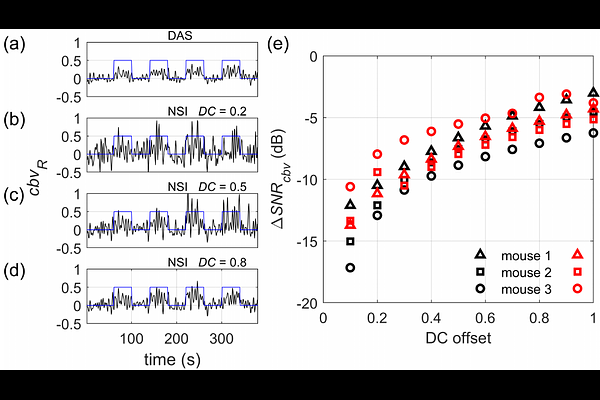
AbstractNull Subtraction Imaging (NSI) is a nonlinear beamforming approach that combines multiple receive apodizations and subtraction to improve spatial resolution in ultrasound imaging. In NSI, a DC offset parameter is introduced in the apodization design to control the sharpening of the effective beam pattern and, therefore, the degree of spatial-resolution enhancement. Here, we investigate the use of NSI in functional ultrasound (fUS) imaging of the mouse brain and compare its performance with conventional delay-and-sum (DAS) beamforming across a range of DC offset values. fUS acquisitions were performed in three anesthetized wild-type mice during periodic vibrissae stimulation. Activation maps were computed by correlating cerebral blood volume (CBV) signals with the stimulation pattern. Activation area, edge gradient, Dice similarity coefficient, and signal-to-noise ratio (SNR) were used to evaluate spatial localization, boundary sharpness, vascular alignment and signal stability, respectively. NSI yielded more spatially confined activation maps than DAS and produced sharper activation boundaries. However, for low DC offsets (< 0.5), the CBV signal exhibited increased fluctuations, which reduced temporal stability and limited the reliability of the functional maps. As the DC offset increased, temporal SNR improved, while the spatial-resolution gain progressively decreased. In our imaging configuration, intermediate DC values around 0.5 provided the most favorable compromise between improved spatial localization and sufficient temporal stability for reliable functional activation detection. These results demonstrate the feasibility of applying NSI to functional ultrasound imaging and provide a quantitative framework for selecting the DC parameter in fUS studies.