Late-infall-induced formation of giant planets, multi-generational planetesimals, and disk substructures

Late-infall-induced formation of giant planets, multi-generational planetesimals, and disk substructures
Haichen Zhao, Tommy Chi Ho Lau, Joanna Drążkowska, Tilman Birnstiel, Sebastian M. Stammler
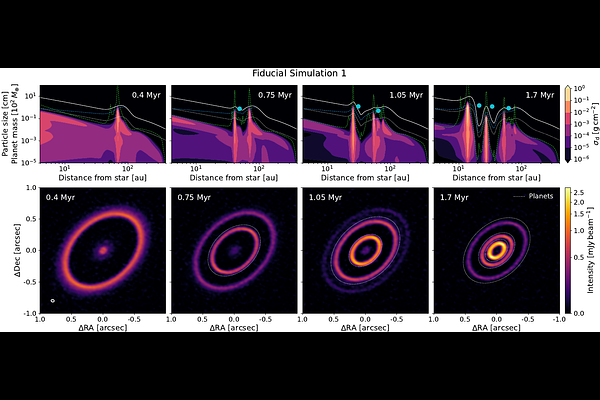
AbstractLate infall can replenish the building materials of planets in protoplanetary disks and dramatically alter their structural evolution. The resulting pressure bumps effectively accumulate dust, facilitate grain coagulation, and trigger planetesimal formation via the streaming instability. In this work, we investigate the potential for planetesimal and planet formation, as well as the emergence of observable substructures, in disks undergoing late-stage infall. We utilize a comprehensive modeling framework that couples dust coagulation and dynamics, planetesimal formation, N-body gravity, planetary growth, and planet-disk interactions. Our results show that the abundant dust supply and the migration barrier created by the infalling gas enable the rapid formation of gas giants via pebble and gas accretion within one million years, even at large orbital distances (~70 au). These giants, in turn, exert torques that generate multiple secondary disk substructures, fostering multi-generational planetesimal formation and resulting in diverse planetary system configurations. The planetesimals exhibit distinct dynamical properties that are determined by their formation epoch and environment, which are analogous to the small-body populations in the outer Solar System. Both the infall- and planet-induced substructures are clearly visible in synthetic 1.3-mm continuum observations, closely resembling the multi-ring disks detected in ALMA surveys. Our model provides a new perspective on the origin of distant giant planets, long-lasting planetesimal formation, and the prevalence of disks with multiple substructures.