The HST/WFC3 Transmission Spectrum of AU Mic b Part I: An Atmosphere Obscured by Contamination and Systematics

The HST/WFC3 Transmission Spectrum of AU Mic b Part I: An Atmosphere Obscured by Contamination and Systematics
William C. Waalkes, Peter Gao, Elisabeth Newton, Brett M. Morris, Zachory K. Berta-Thompson, Hannah R. Wakeford, Lili Alderson, Andrew W. Mann, Peter Plavchan, Patrick J. Lowrance, Natasha E. Batalha, Eric D. Lopez, Roxana Lupu
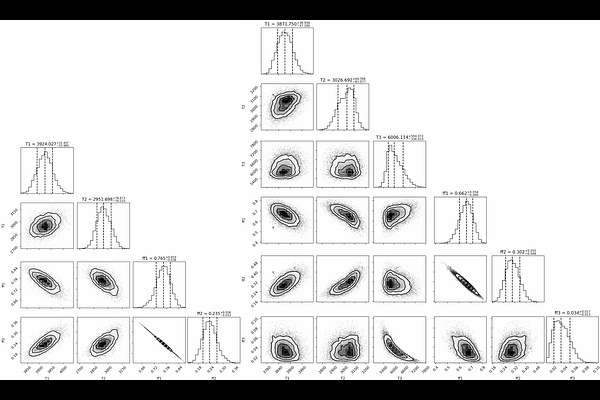
AbstractYoung sub-Neptune progenitors around M dwarfs offer an excellent opportunity to probe the formation of their abundant, older cousins. At $\sim$20 Myr and only 9.7 pc away, AU Mic b is an ideal candidate for this effort, with its density and observations of escaping hydrogen pointing to a significant primordial atmosphere. Here we present the 0.8-1.6 $\micron$ transmission spectrum of AU Mic b observed with the Wide Field Camera 3 on the Hubble Space Telescope (HST). We find that HST experienced unstable scanning during its visits, resulting in a variable PSF that dramatically affects the orbit-to-orbit baseline of the observations. While we were able to somewhat mitigate this problem through spectral binning, the effects cannot be completely eliminated, limiting the precision of our results. Our data is further impacted by the intense magnetic activity of AU Mic, which introduced significant rotational variability along with spot crossings and the transit light source (TLS) effect into the light curves and spectrum, respectively. Through decomposition of the out-of-transit stellar SED, we are able to constrain AU Mic's photospheric and spot temperatures to 3891$\pm$37 and 3020$\pm$69 K, respectively, with a spot filling factor of $0.33\pm0.05$. Using Bayesian atmospheric retrievals, we show that the spectrum is dominated by the TLS effect with weak atmospheric constraints, with the data preferring a relatively small scale height of $<$185 km to 3$σ$. Extrapolation of our retrieved spectra shows that the TLS effect dominates over atmospheric features at optical and infrared wavelengths.